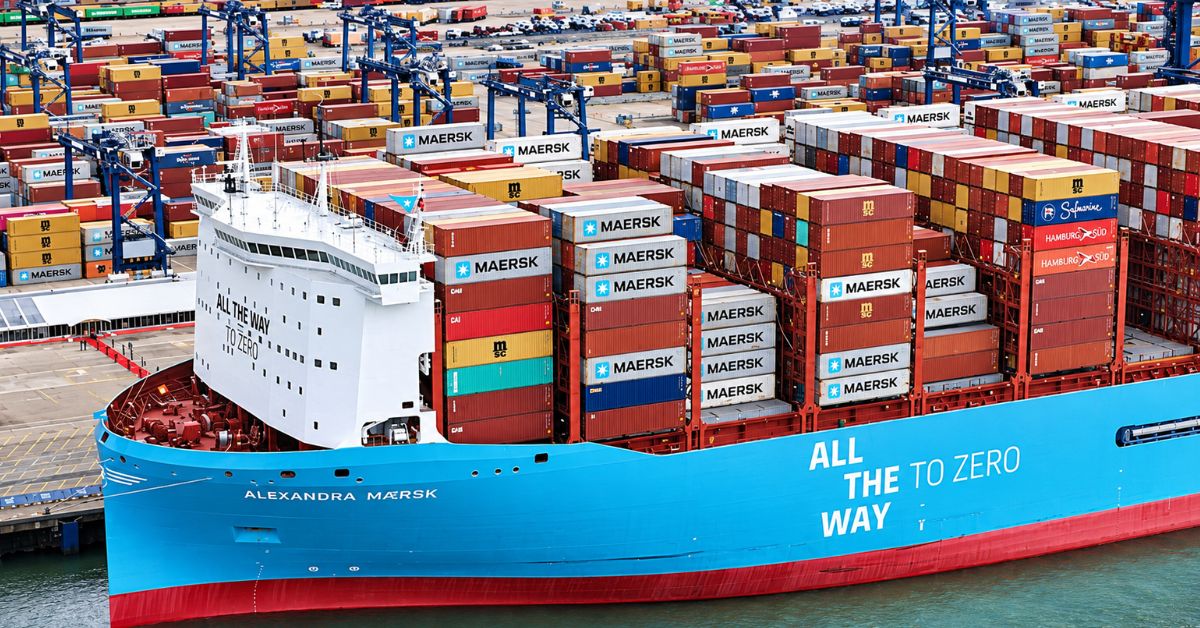

Maersk has revised its Peak Season Surcharge (PSS) for specified Indian Subcontinent origins serving US and Canadian East Coast and Gulf destinations, effective from 8 November 2026. The rates are US$3,850 per applicable container from northwest India, Nepal and Bhutan, and US$4,200 from southern and eastern India, Sri Lanka, Bangladesh and Maldives.
The advisory, issued on 5 November, excludes Houston from the published destination scope. It also states that the surcharge does not apply to Maersk Spot bookings.
Which origins fall under each rate?
The US$3,850 category covers Nhava Sheva, Mundra, Pipavav and Hazira, together with Nepal and Bhutan.
The US$4,200 category covers Ennore, Chennai, Kolkata, Haldia, Visakhapatnam, Cochin, Kattupalli, Krishnapatnam and Tuticorin, alongside Sri Lanka, Bangladesh and Maldives.
Both categories carry the same rate across the equipment groups listed in the advisory. These include 20-foot dry and refrigerated containers, 40-foot dry and high-cube dry containers, 45-foot high-cube dry containers and 40-foot high-cube refrigerated containers.
The destination exclusion is identified by the code USHOU, referring to Houston.
What does the US$350 differential mean for exporters?
The published rates create a US$350-per-container difference between the two origin groups. For example, a shipment of 10 eligible containers would carry a PSS of US$38,500 under the northwest India category and US$42,000 under the southern and eastern India category, a difference of US$3,500.
These amounts represent the surcharge component alone, rather than the complete freight quotation. The differential can therefore inform cost comparisons, but it does not establish which gateway offers the lowest overall transport cost.
Exporters assessing alternative routings would also need to compare inland transport, terminal costs, ocean freight, sailing schedules and delivery requirements. A lower surcharge at one gateway may be offset by the cost or time involved in moving cargo there.
The advisory does not provide the previous rates. The revision should consequently not be described as an increase or reduction without a comparison against the earlier applicable tariff.
Which date determines the applicable surcharge?
For non-Spot bookings, Maersk uses the Price Calculation Date (PCD). For shipments governed by the US Federal Maritime Commission (FMC), this is the last container gate-in date.
For non-FMC shipments, the PCD is the scheduled departure date of the first water leg recorded when the booking is confirmed. The applicable rate therefore cannot be determined solely from the date a customer requests a quotation.
This distinction is relevant for cargo booked before the effective date but moving through the terminal or beginning its sea journey afterwards. Shippers and forwarders need to match the booking category and relevant pricing date when checking the charge.
How should customers compare freight quotations?
Maersk’s general web-booking terms state that accepted bookings are subject to applicable tariff charges, surcharges, adjustment factors, exceptions and exclusions. Customers should therefore compare the complete booking terms rather than treating a single surcharge announcement as an all-inclusive price.
Maersk Spot operates under separate booking terms, which contain provisions covering amendments, cancellations and no-shows. Its exclusion from this PSS advisory does not remove those separate conditions.
For exporters and freight forwarders, the immediate task is to check the origin grouping, destination, equipment type and pricing date against each shipment. Those details determine how the revised surcharge enters the freight calculation and prevent the published rates from being applied to cargo outside the advisory’s scope.
 Join our WhatsApp channel for more updates:
 Subscribe to our YouTube channel for more updates: