
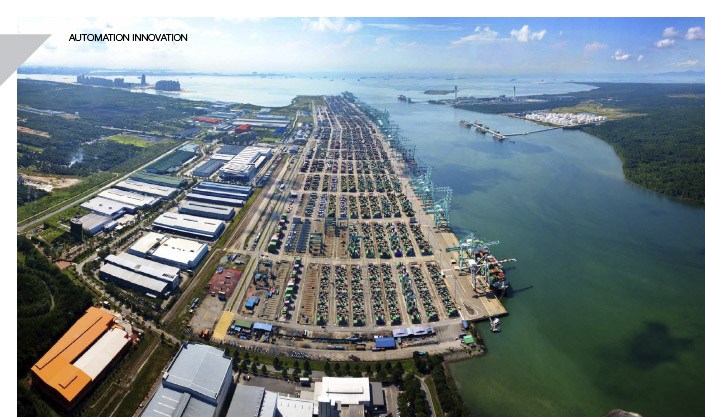
July 31, 2020: As Malaysia continues to develop itself as one of the most important hubs for global trade, the Port of Tanjung Pelepas (PTP) is playing a critical role in this ambition. Part of this transformation is going to be the integration of new and improved technologies, such as automation, new Terminal Operating Systems (TOS) and cloud-based technology. For PTP, to have an advance digital infrastructure is key in ensuring that the port remains ahead of its competitors. Currently, PTP is the third biggest port in Southeast Asia and one of the 20 largest in the world, with approximate terminal capacity of 12.5 million TEU.
GOING LIVE PTP spoke to Port Technology International in a recent interview about its pursuit of greater terminal efficiency and its aim to remain competitive in this fast paced landscape. Equipment automation and digitization have become key focus areas to ensure the port is are able to stay ahead.
For instance, the Opsview Real Time Performance Monitoring System has been integrated at PTP with the aim to improve efficiency, increase berth productivity and reduce operating costs. The system gives PTP the visibility of its live operation performance and all of its assets. The cloud-based system can be viewed from any device and gives a clear understanding towards the utilisation of assets whilst minimising waste and turnaround times of assets. With regards to digital processes, PTP successfully migrated its TOS to Navis N4 in 2019, representing one of the largest such terminal system migration projects yet undertaken at the port. This TOS provides improved performance and scalability to meet the future expected volume growth of PTP.
With Navis N4 in operation, a world record for vessel utilisation was successfully recorded after MSC Gulsun, the largest container ship in the world at the time, departed with 19,574 TEU in July 2019. PTP also recently went live with its 1st Phase intelligent Enterprise Resource Planning system (ERP) to transform and streamline the company’s core back-end operations such as finance, human resources and procurement. With the new ERP system, PTP employees will be able to upscale requisite digital skills and online presence in order to be more efficient while ensuring best practice and service to the customers.
ALL PORTS ON PATHS TO DIGITIZATION
There are numerous ports in the Southeast Asia region that are on a pathway towards more automation and digitization. However, collaboration in the transhipment market is particularly limited because of the competitive nature of the environment. PTP notes that every terminal is trying to develop technologies and or use current technology in a different way to get a commercial advantage and therefore retain and or gain market share via improved productivity and or customer connectivity. However, there are some collaboration possibilities for the Port as two of its shareholders include MMC and APM Terminals. This enables various digitization and automation collaboration initiatives to proceed in terms of knowledge sharing and expertise exchanged between the ports that fall under both groups.
EMPOWERING PEOPLE
It is of course imperative that ports adapt with new digital technologies but PTP also notes that people continue to be the biggest asset for the port. To empower and develop employees towards becoming a high performing workforce, various digitization platforms have been developed, especially for the blue-collar staff to boost their performance and productivity. With the Blue Collar Incentives Application for example, it enables PTP’s blue collar workforce to see live feedback on targets, moves and even how much incentive they will earn at each individual’s end of shift as well as earning projection if they continue to perform at specific self-chosen rate.
Such approach allows PTP to digitize not only its equipment but also its people to make everything and everyone in the port environment a source of data and therefore provide more opportunities to improve, while at the same time limit CAPEX spending and waste accordingly. An asset digitization project is also scheduled for this year to provide a full digitised view of all terminal equipment. All this is in line with PTP’s aspiration to become an advanced preferred port in the region.
COVID-19 AND THE NEW NORMAL
All ports have been impacted by the effects of the COVID-19 and it has left many acknowledging that automation is crucial for being able to handle the crisis and others that may face us in the future. As well many organizations across the globe PTP has implemented a new work policy as well as new shift patterns to accommodate the current business and health situation, meetings and discussion are most done virtually and staff are also encouraged to utilise various digital devices available accordingly.
In addition, with the new ERP system, PTP employees will be able to acclimatise to the new normal by up scaling requisite digital skills and online presence in order to be more efficient while ensuring best practice and service to the customers. Furthermore, this has also allowed the Port to eradicate dependency towards the consumption of paper in its daily business and thus ultimately empowers efforts towards becoming a social and sustainable organization. The availability of application such as Microsoft Teams has greatly assist PTP in managing its day to day business activities, whereas interactive application such as Mentimeter helps people to stay in touch and acquire real-time input from remote teams including feedback, comment, concern and more. Such impact and its effectiveness will not only influence the use of modern technology but most importantly will boost the demand for automation respectively, PTP said.
LOOKING TO THE FUTURE
It is certainly true that PTP is already well on its way to becoming an industry leader in many areas of the port business. PTP is one of the first ports to use the artificial Intelligence (AI) Portchain Real Time Performance Monitoring System which enable us to automatically manage PTP’s berthing line up of over 100 vessels per week. Moving forward, this same use of AI will continue to be adopted in other areas of the business, but with more focus on data predictive analysis for equipment issues, operational bottlenecks and to remove waste. PTP is also looking at using the same technology to interact with customers in relation to accurate discharge and availability of cargo, actual time of arrival, estimated time of departure and more.
In line with this, PTP with the support from its partner’s from Portchain will soon launch the second phase of berthing optimization tool offering full transparency to their customers on information such as live productivity versus target but also breakdowns, crane allocation and much more. In addition, in 2019 PTP signed a Memorandum of Understanding with Terberg Tractors Malaysia (TTM) to explore potential autonomous mobility solutions for its existing terminal tractors. PTP will be supported by APM Terminals in the Proof of Concept (PoC) pilot project, whilst TTM will be supported by Terberg Benschop of the Netherlands.
The proposed solution is aimed to be fully compatible with existing, manually driven, terminal tractors. The aim for PTP is to have a solution that would provide consistent productivity whilst improving the Port’s current performance. The secondary objective would be improving the safety record of terminal tractors, as an autonomous solution should eliminate safety concerns in relation to driver error or fatigue.
PTP said that it is expected that in the near term, due to the current certainties in the world economy and the impact of the COVID-19 pandemic, port operators will be more selective on investment, focusing more on those with firm and certain returns. The use of big data and IoT will therefore be more prevalent based on the impact seen due to the pandemic as working remotely becoming a norm.
Source: PTP









