
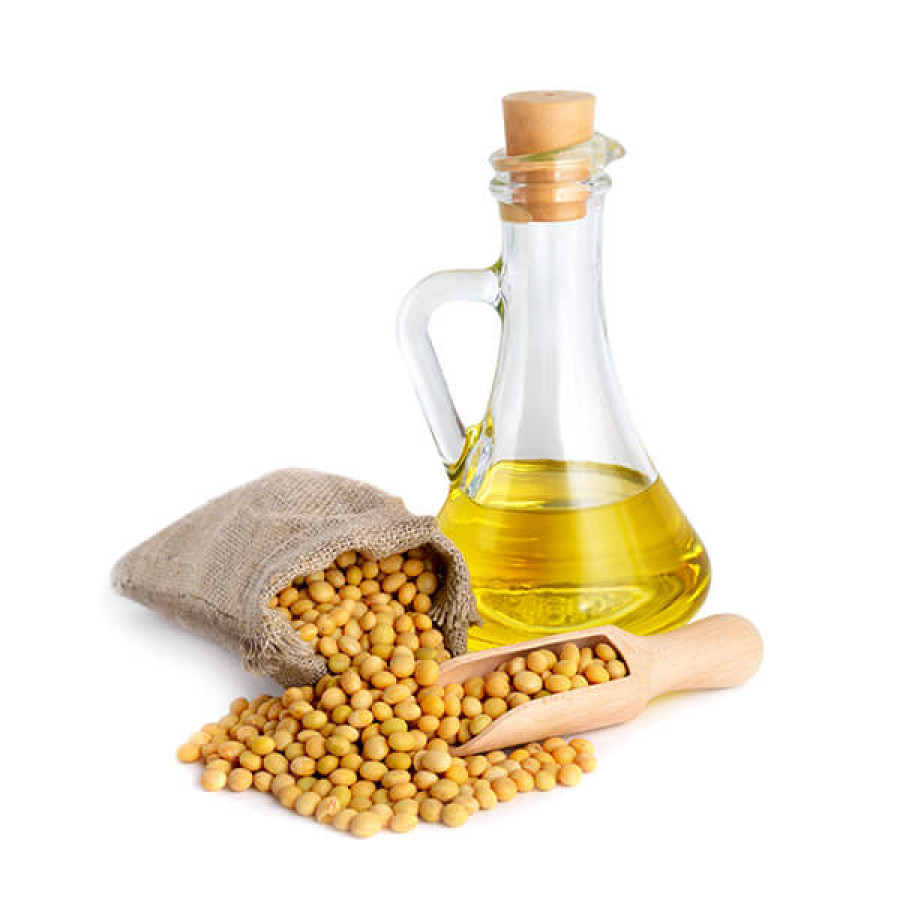
Soybean oil shipments increased four and a half times to Rs13.5 billion in the first five months of the fiscal year.
Soybean oil has shot up to the top of the list of Nepal’s largest exports, knocking palm oil from the number-one spot, as traders changed tack to keep exploiting trade preferential loopholes after the Indian government squeezed palm oil imports.
According to the Department of Customs, soybean oil shipments increased four and a half times year-on-year to Rs13.5 billion from Rs3 billion in the five-month period from mid-July to mid-December in the current fiscal year. In the whole of the last fiscal year 2019-20, Nepal’s soybean oil exports amounted to Rs12.69 billion, the statistics show.
Nepal produces very little soybean oil of its own, and the heady growth is achieved by importing raw oil and re-exporting it after processing.
Tariff exemptions on Nepali exports to India under the South Asian Free Trade Area agreement give domestic traders an advantage. Countries outside of South Asia are slapped with tariffs of 54 percent on palm oil and 45 percent on soybean oil.
According to the Nepal Development Update released by the World Bank in December last year, Nepal capitalised on this arbitrage opportunity and significantly increased exports of the two products—palm oil and soybean oil. “However, it might not be a sustainable option in the long run,” the report said.
The figures show that Nepali traders imported crude soybean oil worth Rs14.67 billion in the review period—mostly from Argentina, Brazil and Paraguay. An examination of the import and export values shows that the overall value addition of the product is just over Rs1 billion.
The South Asian Free Trade Area agreement, to which Nepal is a party, stipulates that goods with preferential origin are eligible to be imported and re-exported with lower duty rates or at zero rates if the requirements are met.
For Nepali exports to India to be eligible for tariff exemptions under this treaty, imported goods need to have at least a 30 percent value addition. Nepali trade experts have been saying that Nepali traders do not meet the 30 percent value addition requirement.
Before soybean oil, palm oil exports reached a record Rs18.31 billion in the last fiscal year. But as soon as the Indian government restricted its export by allowing only licence holders to trade the product, shipments went into a vertical dive.
Trade statistics show that palm oil exports to India plunged to Rs443,000 in the first five months of the current fiscal year, a 99.99 percent drop year-on-year. Palm oil exports had reached Rs11.52 billion in the first five months of 2019-20.
Trade expert Purushottam Ojha said that goods that go under the Nepal India Treaty of Trade are provided duty-free market access with the intention of promoting industrialisation and export of value-added goods. “The goods can be re-exported by adding value to it. But products like soybean oil do not seem to add value in terms of generating revenue and employment,” said the former commerce secretary.
This kind of product is called a ‘rootless’ product, he added. “The export of such products should not be encouraged as it will benefit the traders only as they play on duty arbitrage.”
In the last fiscal year, palm oil became Nepal’s top export product although the country does not produce a drop. The southern neighbour imposed strict measures by allowing licence holders to import palm oil from Nepal in a bid to check cheap imports and protect its domestic industry.
According to Ojha, in the early 2000s, the export of vegetable ghee to India had increased exponentially like is happening with palm and soybean oils. The then Indian government amended the export policy by adding quotas and allowing only State Trading Corporation to import it.
“As a result, exports of vegetable ghee plunged,” said Ojha. In 2009-10, Nepali traders exploited the trade preferential treatment offered on a number of agricultural goods like betel nuts. Later, exploitation was also seen on lentils.
Trade experts said that domestic products are directly impacted if such arbitrage trade systems are not stopped.
Subodh Kumar Gupta, president of the Association of Nepalese Rice, Oil and Pulses Industry, said that the production of soybean is low in the country, and more than 90 percent of the raw materials are imported.
Compared to mustard oil, the consumption of sunflower and soybean oils has increased tremendously. “There are very few factories manufacturing sunflower oil and soybean oil in the country.”
Gupta did not comment on the ballooning exports of soybean oil, but said that was because of trade preferential privilege.
“We should focus on the competitiveness of the industry, the export of soybean oil that is produced in minimal quantities does not have a competitive advantage for the country,” Ojha told the Post. “We need to think of sustainable trade. Not arbitrage trade for short-term profit.”
Source: Kathmandu Post









