
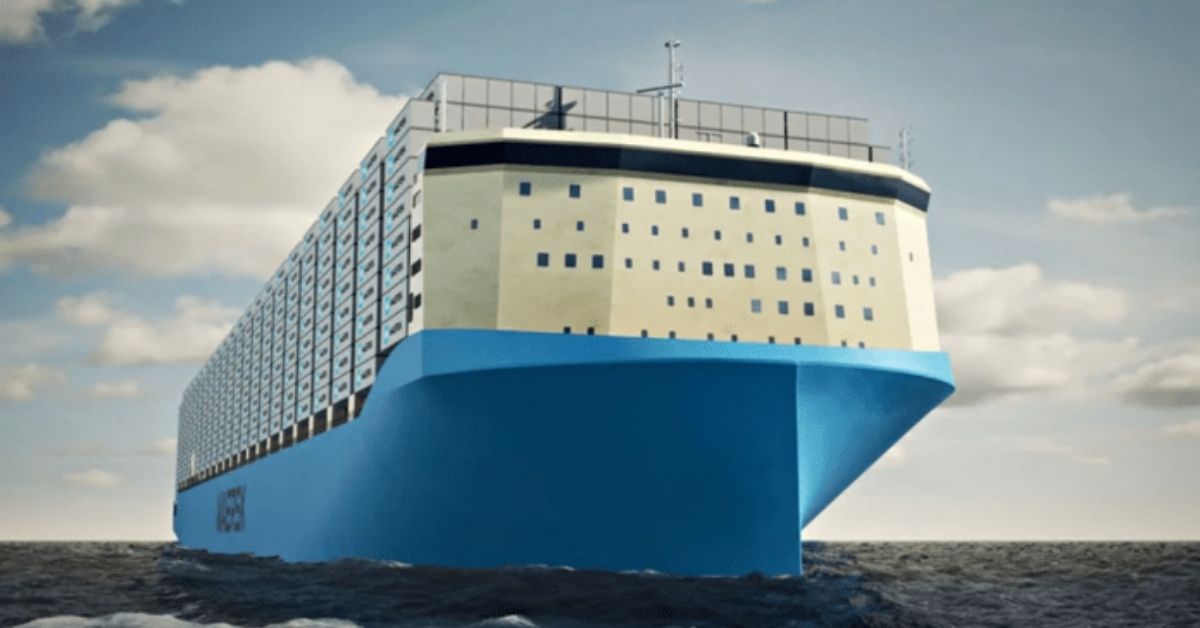
It has largely gone under the radar in the hydrogen sector, but shipping giant AP Moller-Maersk could soon become one of the world’s largest consumers of green H2 after ordering 12 methanol-fuelled container vessels from Korean shipbuilder Hyundai Heavy Industries.
The Danish company says it will reduce its annual CO2 emissions by 1.5 million tonnes when the dozen ships — due to be delivered in 2024 and 2025 — are powered by “carbon-neutral” green methanol produced either from biogas/biomass or renewable hydrogen combined with captured carbon dioxide.
The global maritime sector currently emits 940 million tonnes of CO2 per year — 2.5% of the world’s greenhouse gas emissions — according to the International Maritime Organization, as the bunker fuels it relies upon are among the most carbon-rich fossil fuels out there.
If the world is to reach net-zero emissions by 2050, this dirty fuel needs to be replaced with carbon-free or carbon-neutral alternatives, with three potential fuels now under consideration: hydrogen, ammonia (NH3) and methanol (CH3OH).
Maersk has been the first major shipping company to take the green plunge, opting for methanol — a decision that could have far-reaching consequences.
“It’s a wise move if you’re looking at what’s the path of least resistance from a ship design perspective,” says Bryan Comer, marine programme lead at non-profit International Council on Clean Transportation.
Of the three potential clean shipping fuels, green methanol is the most energy-dense by volume and also the easiest to handle.
Methanol is a liquid at room temperature, unlike ammonia and hydrogen, with an energy density of 16MJ per litre — close to the 21-24MJ/l of liquefied natural gas, which is also used as a shipping fuel.
By contrast, liquid ammonia needs to be stored below minus 33°C and has an energy density of 15.6MJ/l; liquid hydrogen has to be cryogenically frozen at minus 253°C and contains 9.1MJ/l; while compressed hydrogen (at 700 bar) holds only 5.6MJ/l.
But Maersk now faces the challenge of procuring enough biomethanol or so called e-methanol (electro-methanol derived from green hydrogen produced using renewable electricity) to meet its demand — and to ensure that ports create new bunkering facilities to allow the twelve $175m ships to be refuelled.
Berit Hinnemann, Maersk’s head of decarbonisation business development, who has been put in charge of methanol sourcing, says that both types will be needed.
“We see that biomethanol may be faster to scale on the shorter and medium-term, and e-methanol will probably scale afterwards,” she tells Recharge’s sister publication TradeWinds.
“We are engaging with project developers globally, and in general what we see is we will need close collaboration across the value chain.”
Most green hydrogen projects in the pipeline aim to sell compressed or liquefied H2 or green ammonia made by combining the hydrogen with nitrogen from the air. But a handful of projects plan to produce green methanol.
For instance, Swedish developer Liquid Wind plans to build ten commercial-scale e-methanol plants by 2030, while Gasunie New Energy and chemicals firm Nouryon is developing a 20MW facility in the Dutch town of Delfzijl.
Today, methanol is mainly produced from natural gas and used to make chemicals such as formaldehyde, acetic acid and propene for plastics, paints, and cosmetics.
According to Greg Dolan, the chief executive of trade association Methanol Institute, about one million tonnes of biomethanol and e-methanol is expected to be available by 2025, reaching two million tonnes by 2030.
“That is just from announced projects,” he tells TradeWinds. “Basically, every week there is a new announcement.”
Dolan says that biomethanol feedstock, for example from waste streams, is widely available and can be cost-competitive when compared with conventional dirty methanol.
“In some cases… somebody will pay you to take their garbage, so we see biomethanol even today can be affordable.”
Comer explains that not all green methanol is the same when it comes to lifecycle greenhouse gas emissions, and evaluating whether Maersk achieves its carbon-neutral goal will require it to be open about its calculations.
“We need to have them calculate the lifecycle emissions of that feedstock… in a way that their assumptions are transparent, that their methodology is transparent. That way other groups like ourselves can validate their results and see if we agree.”
Carina Krastel, commercial director of the European Green Hydrogen Acceleration Center, tells Recharge that Maersk’s methanol ships provide an example of how expensive renewable H2 can be made commercially viable without subsidies.
“Maersk knows that they can pass [the extra costs from using green methanol] on to [climate-conscious] end customers, for example, an Amazon or a Nike — those guys that actually buy big logistics solutions,” she says.
According to TradeWinds, Maersk’s move into methanol has already created more interest in the potential maritime fuel, with Singapore-based X-Press Feeders ordering 16 small methanol-powered container ships from two Chinese shipbuilders. Maersk also ordered a small methanol feeder vessel from Hyundai back in February last year, later announcing that the annual 10,000 tonnes of green methanol it requires will be supplied by a unit of Danish renewables developer European Energy.
Given its forthcoming head-start in terms of vessels, engines and bunkering facilities, methanol might quickly become the go-to clean fuel for the maritime sector, beating ammonia and hydrogen to the punch.
However, it could be argued that Maersk and X-Press Feeders are still somewhat hedging their bets.
All 29 vessels will actually be powered by dual-fuel engines able to cope with both standard bunker fuel and methanol, while Maersk’s annual emissions savings from the carbon-neutral fuel will only represent 4.5% of the company’s annual fleet emissions.
Maersk ordered the first eight of its methanol container vessels — which measure 350 metres by 53.5 metres — last summer, and confirmed on Monday that it has increased its order to 12.
Source : Recharge News









