
Monday, November 23, 2026
Maritime Gateway
No Result
View All Result
  • Logistics
    • Supply Chain
    • Warehousing
    • Logistics Parks
  • Transport
    • Rail
    • Trucking
    • Multimodal
    • Waterways
  • Global News
    • Americas
    • Asia
    • Europe
    • Middle East
    • Africa
  • Technology
  • More
    • Webinars
    • Reports
    • Newsletters
  • Login
Maritime Gateway
  • Logistics
    • Supply Chain
    • Warehousing
    • Logistics Parks
  • Transport
    • Rail
    • Trucking
    • Multimodal
    • Waterways
  • Global News
    • Americas
    • Asia
    • Europe
    • Middle East
    • Africa
  • Technology
  • More
    • Webinars
    • Reports
    • Newsletters
No Result
View All Result
  • Login
Maritime Gateway
No Result
View All Result

LNG takes off with ordering boom and new bunkering infra

byKalpana Pandey
January 26, 2022
in Bunkering, Global News, News, Shipping
Reading Time: 3 mins read

2021 was a banner year for the expansion of LNG as a marine fuel, according to industry association SEA-LNG. In its annual report, the group pointed to record-setting newbuild orders for dual-fuel LNG vessels and an expanding network of bunkering facilities as further evidence that this fuel option is a popular and growing choice for vessel operators. 

Citing data from Clarksons, SEA-LNG reports that LNG bunkering services will be available in 170 ports by the end of this year. In addition, over the course of 2021, LNG-fueled ships accounted for nearly 30 percent of the newbuild gross tonnage ordered worldwide, hitting a new record. For ULCVs, more than half the orderbook is either LNG-fueled or LNG-ready. 

LNG has been a particularly popular choice in the boxship segment. Over the course of the year, CMA CGM ordered 10 LNG-fueled ships, Zim chartered 10, Hapag-Lloyd took six and MSC switched some of its existing newbuilding orders over to LNG fuel. 

LNG bulkers, ferries and cruise ships are also taking off, and the car carrier segment is extending its interest in LNG. NYK laid out plans to to have 40 LNG-fueled PCTCs in service before the end of the decade, and MOL announced it wants 90 of its own by 2030. They are all expanding their orderbooks to match: UECC ordered three, K Line took eight, NYK took 12, MOL took four and Wallenius took two (with options for four more). 

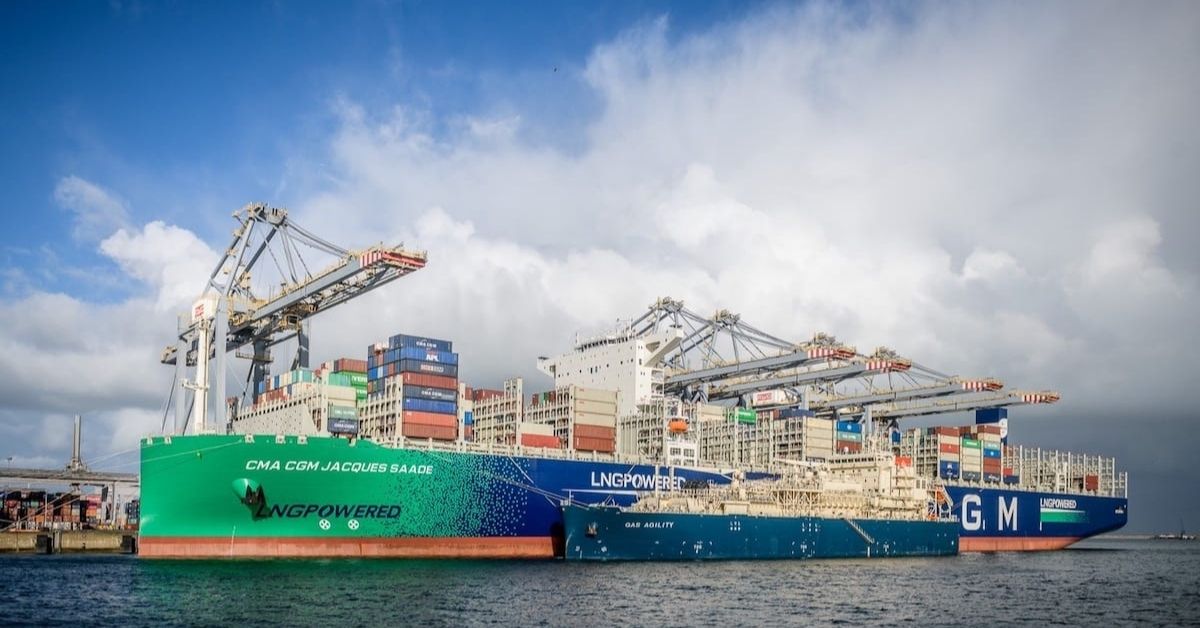
SEA-LNG believes that these orders show the industry’s confidence in the development of future supplies of bio-LNG and synthetic LNG, which could be metered into the supply of fossil LNG as they become available at scale. Quantities of bio-LNG are available today at several European ports, and the fuel has been used commercially at a 13 percent mix ratio by the boxship CMA CGM Jacques Saade. 

The commercial incentives for LNG vessel ownership are also strong, according to SEA-LNG, given the low and stable price of the fuel (under historical market patterns). The group estimated in 2020 that – when compared with other low-sulfur options like scrubbers or VLSFO – LNG offers “the best return on investment over a conservative 10-year horizon, with fast payback periods ranging from one to two years.” LNG dual-fuel propulsion also offers commercial flexibility, as demonstrated in September, when some owners of LNG-fueled tonnage briefly switched to conventional bunker fuel amidst a spike in LNG prices.

SEA-LNG’s research, carried out by consultancy Sphera, suggests that fossil LNG reduces well-to-wake greenhouse gas emissions by up to 23 percent. However, many climate advocates disagree, citing the high rate of methane leakage from natural gas wells, compressor stations and pipelines in many producing regions. Methane – the main component of natural gas – is estimated to be about 86 times more potent than CO2 over a 20-year time scale.

“LNG’s potential to help shipping reach its GHG reduction goals is questionable,” wrote researchers for the World Bank in a report in August. “The availability of large amounts of sustainable and affordable biomass required to produce biomethane [bio-LNG] appears very uncertain. Additionally, synthetic carbon-based fuels like synthetic methane are expected to be more expensive than alternatives like ammonia or hydrogen.”

In response to the World Bank’s note, which advised against investing in LNG as a marine fuel, SEA-LNG said that only time would tell which solutions would help to decarbonize shipping. 

“To suggest that investments not be made in the LNG sector is unwise,” the group wrote in its response. “SEA-LNG believes strongly that the transition to future fuels must not follow this prescriptive approach. It is far too early to decide what the real potential of various alternatives fuels will be for a highly complex, hard-to-abate, global industry.”

Source : Maritime Executive

Tags: bunkeringLNGmarine fuelship fuel

Kalpana Pandey

The Maritime Gateway Editorial Team delivers trusted news, analysis, and insights on shipping, ports, logistics, supply chains, and global trade, backed by industry expertise and editorial review.

Related Posts

India ship entry rules add salvage and pollution-response checks
Customs

India ship entry rules add salvage and pollution-response checks

October 10, 2026
NCT concession keeps ownership with Bangladesh
Asia

NCT concession keeps ownership with Bangladesh, says shipping minister

October 10, 2026
Major Ports Cargo Traffic Climbs 8% in First Half of FY27
Cargo

Major Ports Cargo Traffic Climbs 8% in First Half of FY27 as Growth Gathers Pace

October 10, 2026
Trichy Dry Port Moves Ahead
Cargo

Trichy Dry Port Moves Ahead as Tamil Nadu Shortlists Sites for Multimodal Logistics Hub

October 10, 2026

Leave a Reply Cancel reply

Your email address will not be published. Required fields are marked *

Popular News

No Content Available
[mc4wp_form]
Next Post
Bunker prices to remain high

Bunker prices to remain high

A modern news portal designed for daily coverage of breaking stories, global events, politics, business, technology, sports, and entertainment. Built to deliver fast, reliable, and engaging journalism across every major news category.
[mc4wp_form]
Browse by Category
  • 2008
  • 2009
  • 2010
  • 2012
  • 2013
  • 2014
  • 2015
  • 2016
  • 2017
  • 2018
  • 2019
  • 2020
  • 2021
  • 2022
  • 2023
  • 2024
  • 2025
  • 2026
  • Africa
  • Air Cargo
  • Americas
  • Articles
  • Asia
  • Bulk Ports
  • Bunkering
  • Business
  • Cargo
  • Container Terminals
  • Containers
  • Customs
  • Digital Dialogues
  • Dry Bulk
  • Economy
  • Entertainment
  • Equipment
  • Europe
  • EXIM
  • Featured
  • Forwarding
  • Global News
  • Government
  • Interviews
  • Lifestyle
  • Liquid Bulk
  • LNG
  • Logistics
  • Logistics Parks
  • Magazines
  • Main Line Operators
  • Middle East
  • Multimodal
  • National
  • News
  • Newsletters
  • NVOCC
  • Policy
  • Politics
  • Ports
  • Project Cargo
  • Rail
  • Recommended
  • Reports
  • Science
  • Shipping
  • Sports
  • Supply Chain
  • Tankers
  • Tech
  • Technology
  • Transport
  • Trending
  • Trucking
  • Uncategorized
  • Warehousing
  • Waterways
  • Webinars
  • World

Site Links

  • Site Admin
  • Log Out
  • Entries Feed
  • Comment Feed

Download Our App

Follow Us

© 2026 JNews – Premium WordPress news & magazine theme by Jegtheme.
  • Terms of Use
  • Privacy Policy
  • Manage Cookies
  • License

Welcome Back!

Login to your account below

Forgotten Password?

Retrieve your password

Please enter your username or email address to reset your password.

Log In
No Result
View All Result
  • Home
  • Politics
  • World
  • Business
  • Science
  • National
  • Entertainment
  • Lifestyle
  • Tech

© 2026 JNews - Premium WordPress news & magazine theme by Jegtheme.







