
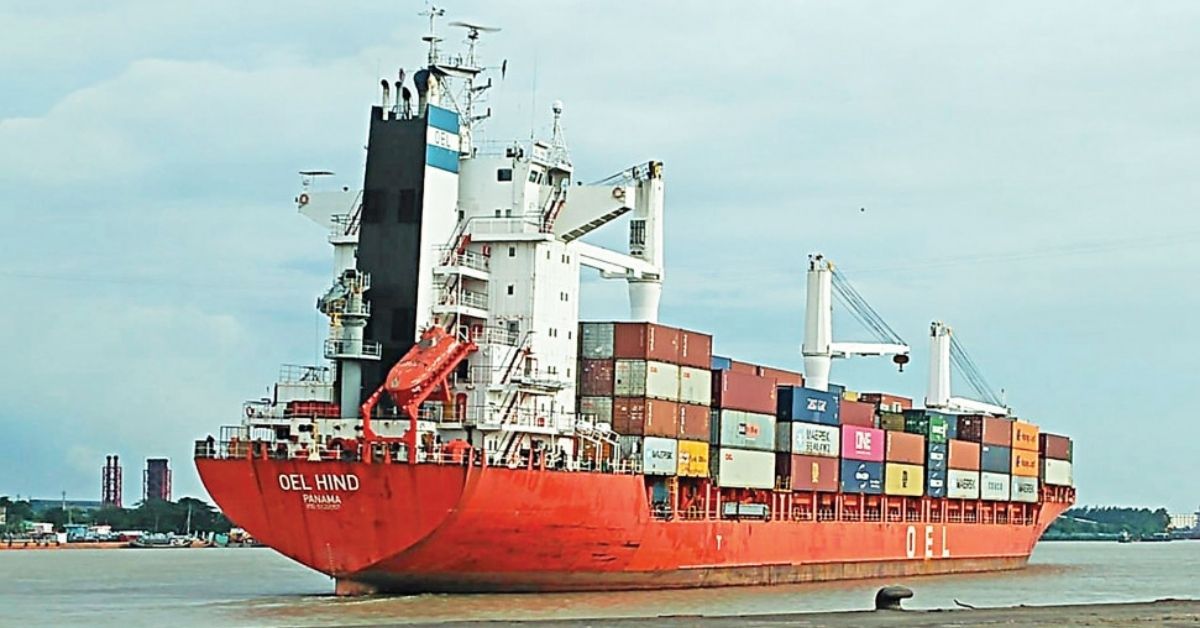
Container shipping rates plunge by 40% but global macroeconomic scenario cast gloom over India’s exporters
The cost of shipping goods in steel containers out of India has dropped since August by as much as 40 per cent and is sliding further reflecting a broader global trend as the uncertain macro-economic scenario and market fundamentals puts a leash on the soaring rates seen in the last two years.
“Container freight rates out of India are sliding and sliding very fast,” said an executive with an ocean carrier. “Every 3-4 days or a week, the rates are dropping by about $200-300 for a twenty-foot equivalent unit (TEU). We don’t know how it will look tomorrow or the day after. It’s so volatile,” the executive remarked.
Freight rates on the India to Europe trade has dropped to around $3,500 for a twenty-foot equivalent unit (TEU) from about $5,000 dollars a few months ago. The rates on the China to India sector is about $600 for a TEU and around $1,000 for a forty-foot equivalent unit (FEU).
The significant softening of rates comes during what is generally regarded as the peak season for container shipping, in the run up to the Christmas holidays in the West.
“It should be the peak period now but when we say peak period, we must also consider what is the condition in Europe whether people are going to buy during this peak season with the kind of inflation, the kind of energy crisis and water crisis which are going on there. If we still expect this to be a peak season, then I think we are expecting too much,” said the executive based in Mumbai.
A second executive with one of the global top three container carriers told ET Infra that there has been a 30-40 per cent drop in the freight rates compared to rates in the beginning of September.
“It has still not reached the pre-pandemic levels. If you talk about pre-pandemic levels, the rates now would still be at least around 115 per cent of what it used to be,” he stated.
In September, spot rates on many trades fell by their largest margin yet as lower global demand and easing global congestion saw shippers (exporters and importers) gain a decisive advantage, according to a September report by Oslo, Norway-based Xeneta A S, one of the world’s top ocean and air freight rate benchmarking and market analytics platform.
The Xeneta Shipping Index (XSI) saw its first month-on-month fall since January this year and one of only three declines in the past 21 months, as it slid to 448.3 in September, a drop of 1.1 percent.
Lower rates for new contracts and shippers’ success in renegotiating the freight rates of older long-term contracts in exchange for delivering more volumes to their carriers are other reasons behind the first drop in all the valid long-term contract rates since January, Xeneta said.
However, Xeneta expects it won’t be the last, with market fundamentals suggesting that the “halcyon days” of ever-increasing rates for carriers may be drawing to a close.
In late August, Xeneta indicated that the new long-term contracted rates were starting to drop on key trading corridors, following on the heels of declining spot prices. However, due to the fact they’re replacing expiring agreements with considerably lower rates, the average paid by all shippers was still seen to be climbing.
“There’s no doubt the major carriers have had it their way in negotiations for some time,” Patrik Berglund, Xeneta CEO said in August. “The spectacular results they saw in 2021 will no doubt be repeated, and even bettered, this year, as seen by the huge profits that defined many Q2 financial reports. But there is a sense that change is in the air,” he noted.
“Volumes are dropping and as expected, long-term rates are beginning to follow the trend set by the spot market. When you add in an uncertain macroeconomic outlook, continuing supply chain issues – such as the industrial action we’ve seen occurring, or threatened, in major ports in Germany, UK, and the US – and disruption in China due to the zero-Covid policy, it’s an unpleasant cocktail for the industry to swallow,” he said.
“In addition, you also have problems seemingly exacerbated by climate change, with low water levels impacting both power and factory production, as well as hinterland logistics chains,” he stated.
“Overseas freight has gone up by 300-350 per cent from pre-covid levels and though there is little correction in the freight rate recently, freight rates are still 200-250 per cent more than at 2019 levels,” A Sakthivel, President, Federation of Indian Export Organisations (FIEO) told Finance Minister Nirmala Sitharaman in a 2 October email while seeking continuation of the exemption from Goods and Services Tax (GST) on export freight.
“Government policies are going totally against the trade. I don’t know what they are trying to do, it’s not helping the trade much,” said a third executive with a European container shipping line.
“There is a restriction on export of broken rice, and we were exporting broken rice to Southeast Asia and Asia. That trade has completely stopped. With regards to the normal rice, despite having a good monsoon this year and adequate stocks of the staple, the government has imposed an export duty of 20 per cent on rice. On steel, the government has put a 15 per cent export duty. So, what happens, India’s exports are going to go down,” he explained.
FIEO President Sakthivel alluded to this when he told the finance minister that “the global trade is entering a very difficult phase as countries are facing high inflation and impending recession affecting the demand”. This, he said, is evident from India’s slowing export growth rate between April and August.
India’s goods exports dropped 3.5 per cent in September to $32.62 billion, while imports slid below $60 billion for the first time in seven months to $59.35 billion. The trade deficit stood at $26.73 billion for the month.
This is the first contraction in exports since February 2021 and the trade deficit is almost 19 per cent higher than a year ago.
Restrictions on exports of broken rice and a 20 per cent export tax on other varieties of the cereal led to a nearly 6 per cent drop in its exports during September, government data showed.
Carriers operating into and out of India have started re-introducing blank sailings (no shows) to manage capacity.
“When people say blank sailings, carriers are going to blank to get the results,” said the executive with the European container line mentioned earlier.
“There are ships, and we are paying for those vessels every day. The charter hire of a container ship today is about $1,40,000 per day. Why would anybody blank sailings? Carriers are blanking sailings because the vessels are not coming back on time due to congestion in key global trading ports. We are speeding up, but for every five days, we can speed up the vessel by a maximum of one day and that’s not enough to make up for lost time,” he observed.
For instance, if the voyage time from New York to India or vice versa is 20 days, the maximum a ship can save by speeding up is four days.
“How will the ship recover the 12 extra days spent waiting outside New York to berth. So, what will happen is you will have a blank and it’s not that all the vessels have got a similar kind of a delay because if a vessel confronts heavy congestion in New York, it goes to some other ports for unloading the containers and the entire schedule is disturbed. Besides, if you speed up, you will burn more bunker, raising the voyage costs,” he said. “Luckily, the volume is low and because of that the freight rates are softening. It’s a demand and supply situation, simple,” he added.









