
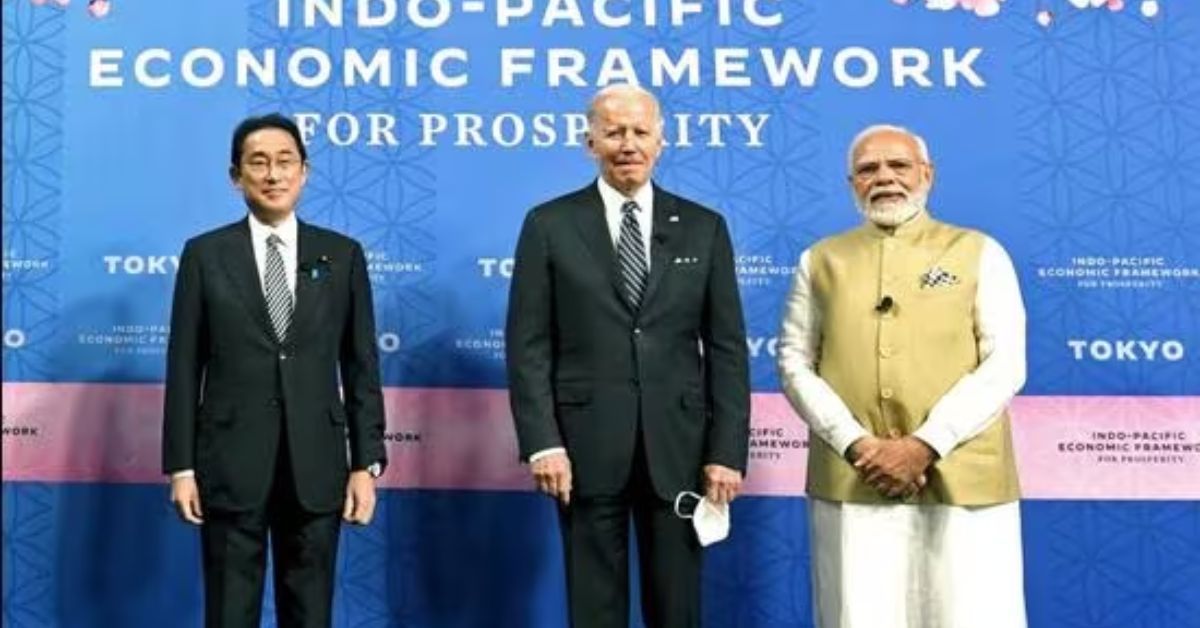
In a clear bid to reduce their reliance on China, and meet future supply chain crises, 14 participant countries in the Indo-Pacific Economic Framework (IPEF), including the United States (US) and India, have struck a deal on supply chain resilience and diversification through information-sharing and coordinated crisis response.
At the second in-person ministerial meeting of IPEF countries in Detroit this weekend, the grouping agreed to set up an IPEF supply chain council, supply chain crisis response network and labour rights advisory network, according to a statement put out by the group.
IPEF also outlined the progress on the trade, clean economy and fair economy pillars of the framework. Under the clean economy framework, interested members have agreed to set up a regional hydrogen initiative.
India has joined three of the four pillars of IPEF, while remaining an observer in the trade pillar. At the ministerial, minister for industry and commerce Piyush Goyal represented New Delhi virtually. Goyal tweeted, “Reiterated India’s commitment towards building resilient supply chains and a clean & fair economy to spur further growth in the region.”
Announcing the deal, the US commerce secretary Gina Raimondo tweeted that she was glad to announce that IPEF had substantially concluded negotiations on a “first-of-its-kind” supply chain agreement. “It’s a big deal — and the first time there will be an international agreement on supply chains that brings together 14 partners across the Indo-Pacific.”
The deal has to be translated into a final text and then is subject to the domestic approval processes in each country. Besides the US and India, IPEF members include Australia, Brunei, Fiji, Indonesia, Japan, South Korea, Malaysia, New Zealand, Philippines, Singapore, Thailand and Vietnam.
In a statement, IPEF members said that the deal on supply chains aimed to increase the “resilience, efficiency, productivity, sustainability, transparency, diversification, security, fairness, and inclusivity of their supply chains” through both collaborative activities and individual actions by each state.
Outlining the objectives of the agreement, the members said that it was meant to provide a framework to “build their collective understanding of significant supply chain risks, supported by each partner’s identification and monitoring of its own critical sectors and key goods”. The pact is also geared at improving “crisis coordination and response to supply chain disruptions” through collaborations in supporting the timely delivery of affected goods.
It will facilitate cooperation, mobilise investments and promote regulatory transparency in sectors “critical to national security, public health and safety, or the prevention of significant or widespread economic disruptions”; respect, promote and realise, “in good faith”, labour rights in the supply chains of partner countries; ensure availability of adequate skilled workforce in critical sectors and identify opportunities for technical assistance.
The statement suggests that IPEF members have agreed to do so by respecting market principles, minimising market distortions, including unnecessary restrictions and impediments to trade, and protecting the confidential information of businesses.
In order to meet these objectives, the grouping has agreed to set up three institutions.
IPEF supply chain council will provide a mechanism work for members to work together to develop “sector-specific action plans for critical sectors and key goods” to enhance resilience, “including through diversification of sources, infrastructure and workforce development, enhanced logistics connectivity, business matching, joint research and development, and trade facilitation”.
IPEF supply chain crisis response network will serve as an “emergency communication channel” for members to seek support during disruptions and facilitate information-sharing. And the IPEF labour rights advisory board will be a multi-stakeholder body supporting promotion of labour rights in supply chains, sustainable trade and investment and facilitation of opportunities for investments in labour-friendly businesses. It is noteworthy that the labour-related body is merely advisory in nature and does not entail hard and specific commitments from members.
On clean economy, IPEF members said they are exploring ways to meet their climate goals and will cooperate on “research, development, commercialization, availability, accessibility, and deployment of clean energy and climate friendly technologies, and facilitate investment towards climate-related projects in the region”.
The grouping said it will do so by connecting markets through policies and standards, “ensuring that energy is sustainable, resilient, reliable, and affordable, and promoting low-and zero-emission goods and services”. To deliver concrete benefits, IPEF members are currently, according to a statement, identifying and developing initiatives to advance cooperation in areas critical to realise their “unique pathways towards net-zero emission economies”. Among these initiatives, interested IPEF members have agreed on a “regional hydrogen initiative to encourage widespread deployment of low-carbon and renewable hydrogen and its derivatives”.
In terms of the fair economy pillar, IPEF welcomed progress on “effectively implementing and accelerating progress on anti-corruption measures and tax initiatives, including through enhanced cooperation on capacity building and technical assistance”.
While India isn’t a part of the trade pillar, the other IPEF members affirmed their commitment to “craft high-standard, inclusive, free, fair, and open trade commitments that build upon the rules-based multilateral trading system.”









