
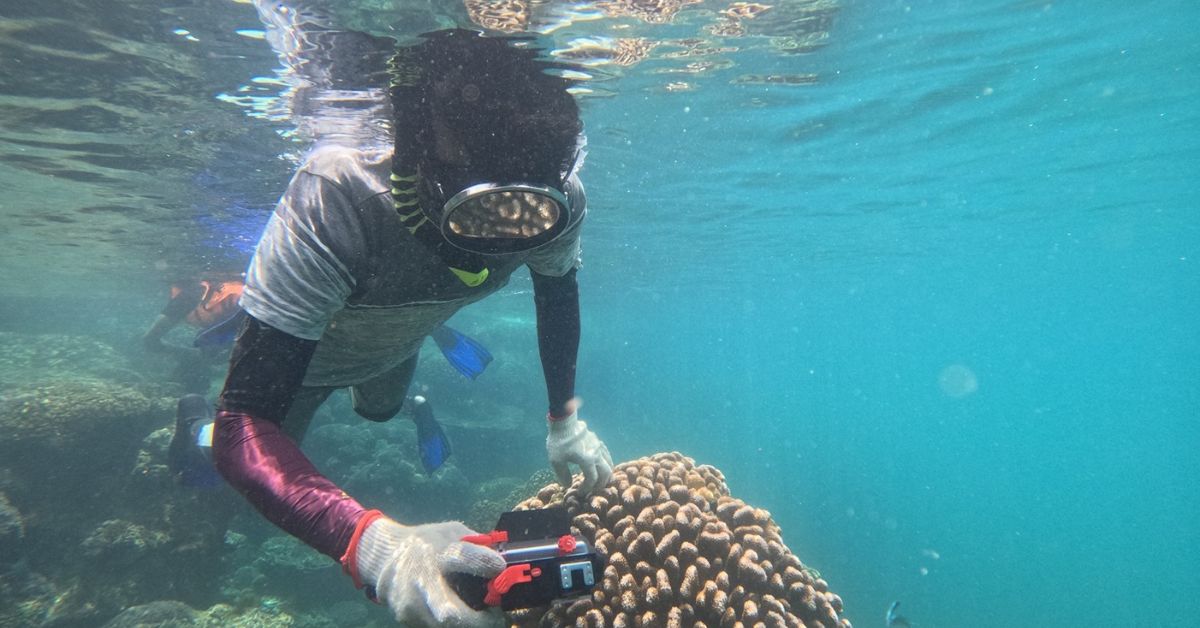
Hambantota International Port (HIP) is redefining what industrial infrastructure can achieve, not just as a logistics hub, but as a thriving marine ecosystem and research site. A recent coral reef study conducted at HIP’s breakwater by the Ocean University of Sri Lanka (OCUSL) has revealed an extraordinary ecological discovery: around 35% of the observed coral coverage in the area is live, positioning HIP as one of the most vibrant artificial reef systems in Sri Lanka.
Led by Dr. M.F.M. Fairoz, marine scientist and Senior Lecturer at the Faculty of Fisheries and Ocean Science, the OCUSL team explored the port’s semi-artificial reef system, which has developed within a high-security, low-disturbance zone. This unique setting has allowed coral larvae to successfully settle and grow on the breakwater’s stable substrate.
“It’s like a living laboratory,” said Dr. Fairoz. “This reef is protected from many of the stressors we see in natural coastal areas; no fishing, limited pollution, and a healthy balance of reef-associated species. The fact that 35% of the coral cover is live is a remarkable indicator of the ecosystem’s resilience and health.”
This finding is particularly significant when compared to other coral reef sites in Sri Lanka, many of which have seen live coral coverage drop below 20% due to water pollution, fishing pressure, coastal development and climate change. In contrast, HIP’s sheltered reef system stands as a beacon of hope for reef regeneration and marine biodiversity.
The breakwater reef at HIP is now the second major coral reef protection initiative in the country, following the one at Port City Colombo. However, HIP’s breakwaters, subjected to natural recruitment of reef building corals to a thriving reef system, without extensive artificial intervention, make it especially noteworthy. Researchers recorded a diverse marine community, including several species of hard and soft corals, sponges, and over 20 species of reef-associated fish. These are all strong indicators of a low-pollution, balanced marine habitat.
Dr. Fairoz and his team are now studying how artificial substrates, like the breakwater can be optimised to promote coral settlement and growth, an area gaining global interest as scientists explore coral restoration, reef engineering, and carbon sequestration. “We’re using advanced ecological models to understand energy flow through this system and to identify design principles for future marine infrastructure projects worldwide,” he explained.
The study aligns closely with the Hambantota International Port Group’s (HIPG) broader ESG strategy, integrating biodiversity protection into its operational DNA. HIP’s approach integrates scientific research directly into its long-term sustainability agenda. This commitment supports the United Nations Sustainable Development Goal No.14: Life Below Water.
Wilson Qu, CEO of HIPG said, “Our majority partner, CMPort, believes environmental protection is a global responsibility. Since 2008, CMPort has expanded operations to 25 countries, adapting to local environmental standards while prioritising ecosystem protection. The preservation of HIP’s coral reef is a clear demonstration of this principle in action.”
Five senior OCUSL students participated in the project, contributing to data collection in sediment analysis, fish biomass studies, and coral-microbial interactions. Their findings will be published in international scientific journals, showcasing HIP as a key platform for nurturing the next generation of Sri Lankan marine scientists.
The upcoming phase will see the research team compiling their findings into a comprehensive book, offering data-driven recommendations for ongoing reef protection. Both digital and print editions are planned, ensuring the insights reach local communities, policymakers, and international stakeholders.
“This is more than just a regular commercial port,” concluded Dr. Fairoz. “With 35% live coral coverage, Hambantota International Port proves that even high-functioning industrial zones can support living, breathing marine ecosystems. This is where science, sustainability, port operations and innovation come together.”









