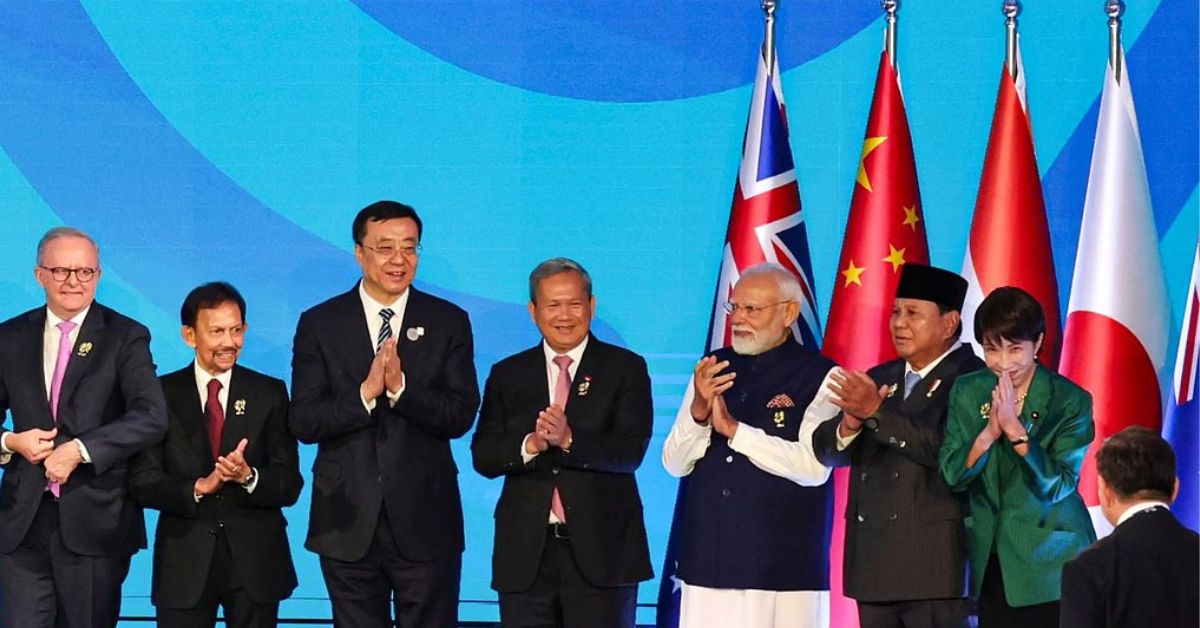

Prime Minister Narendra Modi announced a Seafarers’ Safety Initiative at the 21st East Asia Summit in Manila on 17 November 2026, seeking stronger international cooperation in joint training and emergency response. The announcement comes as attacks on commercial shipping continue to endanger crews and disrupt international waterways.
Addressing leaders hosted by Philippine President Ferdinand R. Marcos Jr., Modi called for greater protection of merchant vessels and seafarers. He also highlighted how conflicts are placing pressure on global food, fuel and fertiliser supplies.
What will the Seafarers’ Safety Initiative cover?
The initiative’s announced focus is cooperation in joint training and emergency response, bringing crew protection into the East Asia Summit’s regional security agenda.
“Our seas are the lifelines of our shared prosperity,” Modi said, linking maritime security and freedom of navigation to collective responsibility.
The announcement establishes the initiative’s broad direction. It does not specify a budget, participating agencies, training locations or an implementation timetable. These details will determine how the proposed cooperation translates into practical support during maritime emergencies.
Modi reaffirmed India’s commitment to a free, open, inclusive and rules-based Indo-Pacific, while supporting efforts towards peaceful resolution of conflicts in Ukraine and West Asia.
How does it connect with ASEAN–India maritime cooperation?
The seafarer initiative was accompanied by a separate proposal at the 23rd India–Association of Southeast Asian Nations (ASEAN) Summit in Manila.
India proposed a long-term maritime cooperation plan covering connectivity, scientific research, disaster management, Coast Guard cooperation, maritime domain awareness and seafarers’ security. These areas extend the bilateral partnership’s maritime agenda beyond trade links to include preparedness and operational cooperation.
The leaders also adopted an ASEAN–India Joint Statement on Cooperation in Disaster Management. The maritime plan was listed among India’s proposals, making it distinct from that formally adopted statement.
The announcements come ahead of the 35th anniversary of ASEAN–India relations in 2027, which will also mark five years of their Comprehensive Strategic Partnership.
Why has crew protection become more urgent?
The International Maritime Organization (IMO) has recently renewed its call for stronger safeguards for seafarers caught in geopolitical conflicts.
Following its Council meeting in London from 2–6 November, the organisation said essential shipping lanes must remain open and secure, and crews must be protected regardless of nationality.
In its 6 November statement, IMO reported at least 130 verified attacks against commercial vessels in the Middle East region and 25 confirmed seafarer deaths since the conflict began. These figures were the organisation’s assessment at that date.
The Council also condemned attacks on merchant shipping in the Red Sea and Black Sea. Secretary-General Arsenio Dominguez highlighted injuries, abandonment, blocked repatriation and shortages of basic necessities among the consequences faced by crews.
What response measures has India already taken?
India’s maritime administration introduced emergency coordination measures earlier this year. On 2 March, the Directorate General of Shipping announced a dedicated quick-response team to coordinate assistance, evacuation support and communication for Indian seafarers affected by the Persian Gulf crisis.
The measures included enhanced vessel monitoring, more frequent reporting and coordination with the Indian Navy, Ministry of External Affairs and Indian diplomatic missions.
Shipping companies were advised to maintain contact with seafarers and their families, undertake voyage-specific risk assessments and review transits through high-risk areas against prevailing conditions. These measures provide domestic context for India’s latest call for wider international cooperation.
Alongside the safety initiative, India announced plans for an East Asia Summit Maritime Heritage Festival at Lothal, a cybercrime conference and a university conclave at Nalanda, broadening the summit’s cooperation agenda across maritime heritage, digital security and education.
 Join our WhatsApp channel for more updates:
 Subscribe to our YouTube channel for more updates: