
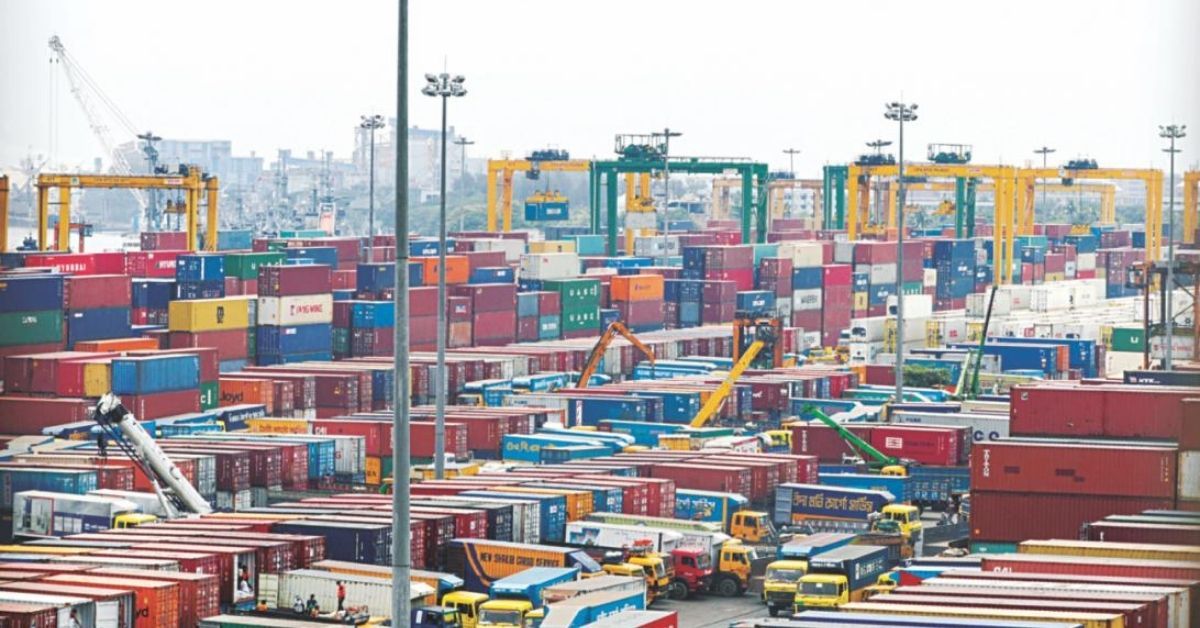
The Bangladeshi freight forwarding sector is an invisible backbone of the country’s economy. Without the freight and logistics sector, the entire supply chain management is simply a car without an engine.
Modern international trade consists of sophisticated interactions between individuals, corporations, and organisations; therefore, a robust, experienced, and professional freight forwarding industry is crucial for promoting and facilitating the nation’s foreign trade.
A recent study presented at an American Chamber of Commerce in Bangladesh (AMCHAM) session on logistic discourse showed that efficient logistics alone might increase Bangladesh’s exports by 20%. According to estimates, Bangladesh’s logistics business will exceed $90 billion by 2025.
Freight forwarding is the most significant part of the logistics industry. Currently, over 1,100 BAFFA members facilitate the nation’s international trade with global origins and destinations.
Before LDC graduation, the country’s foreign trade will surpass $100 billion. It may be questioned why Bangladesh was unable to achieve logistical efficiency.
The reason is that policies are not agreeable and compliant with international norms. Container ports worldwide operate as terminal operators only, not as storage and delivery yards.
In contrast, Chattogram and Mongla took on the responsibility of storing import containers and facilitating delivery from within the port, causing congestion and a security hazard due to the thousands of trucks and labourers entering the port daily.
All exports are now stored in Inland Container Depots (ICD) outside the port, which has helped to alleviate congestion in Chattogram port to some extent.
Still, globally, ICDs or dry ports serve solely as laden import and empty container storage and FCL delivery yards, and not as Container Freight Stations (CFS). CFS are operated globally by freight forwarders.
Initially, allowing freight forwarders to operate CFS on easy terms (in owned or leased warehouses) for exports in Bangladesh will eliminate port congestion and prevent export vehicles from queuing during peak hours.
In neighbouring India, freight forwarders operate 400 CFS with a license and another 1,000 without a license. Singapore is a striking illustration of how an effective freight forwarding and logistics sector enabled the country to become one of the world’s leading economies despite not having natural resources.
Vision 2041 of our Honorable Prime Minister to graduate Bangladesh from LDC to one of the top economies in the world will require significant capacity building, particularly with human resources, to tackle global challenges and adhere to international trade restrictions.
The current government has exerted maximum effort and committed sufficient financial resources for enormous infrastructure development, including establishing 100 special economic zones.
National policies and the eighth five-year plan have also emphasised commerce and industrial logistics as essential catalysts for private sector-led development.
To shoulder the government development schemes, the private sector should support, invest in, and update the infrastructural and human resources index, the primary driving force behind any development where we need to go a great distance.
LDC graduation will necessitate the development of our Human Resource Development (HRD) capacity to meet the challenges of export diversification, trade facilitation, easing and reducing the cost of doing business, and eliminating conflicts of interest among too many players that cause the highest cost of doing business in the region.
It is important to note that nine ministries and 21 departments oversee the logistics industry in the country, which complicates its operation.
Coordination is required to assure ease of doing business, enhance trade facilitation, and reduce business costs to bring our logistics index closer to the global norm.
Neighbouring India established a separate logistics division within the Ministry of Commerce in 2015 for planning and implementation of public sector logistical infrastructures, the supervision of private sector logistics infrastructure development, and the formulation of compatible international trade rules and regulations in consultation with public and private sector stakeholders.
We suggest the government establish a single body to manage the logistics industry. This will help promote and legitimise trade facilitations by removing many superfluous and unjustifiable barriers.
Bangladesh Freight Forwarders Association (BAFFA), with assistance from USAID, supports Feed the Future initiative. Bangladesh Trade Activity, in collaboration with Chittagong Independent University, will introduce a diploma in logistics and supply chain management in January 2023, with the intention of creating a pool of qualified human resources to serve the logistics sector, which is likely to be re-validated by International Federation of Freight Forwarders Associations (FIATA), a globally recognised authority.
Since the official education system of the country does not contain fieldwork experience to meet industry needs, the government must implement a unique programme with a variety of internship schemes to support skill development projects involving hundreds of trade organisations.
The government’s HRD and skill development initiatives should include recent college and university graduates seeking employment prospects.
All parties involved in Bangladesh’s international trade, including policymakers, should recognise the significance of internship programmes and create appropriate rules and regulations in a coordinated and cohesive manner so that policy support helps congenial logistics services to promote Bangladesh’s foreign trade, thereby contributing to the successful realisation of vision 2041.









