
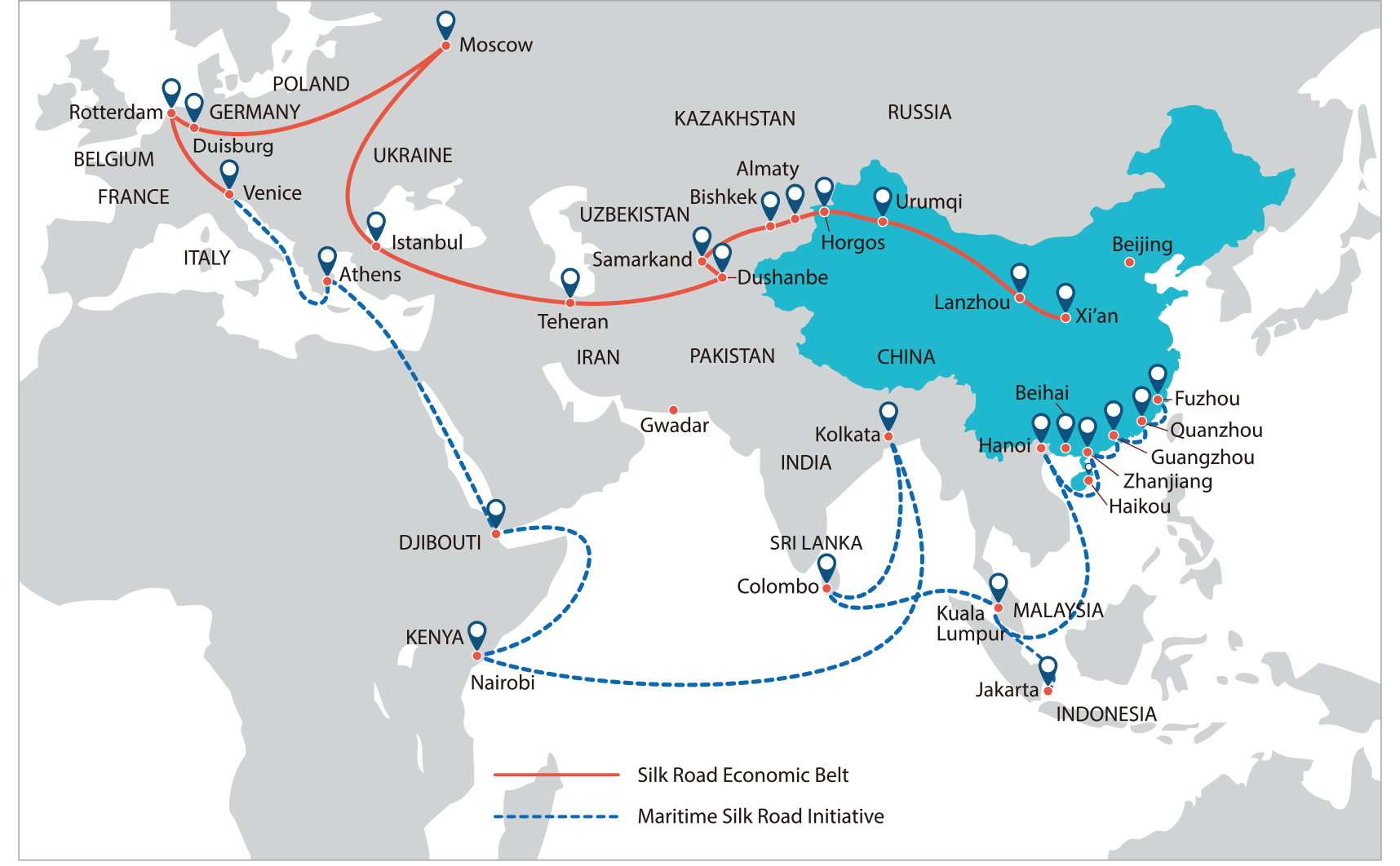
July 07, 2020: Supply chain issues and severely limited movement of key personnel during lockdowns have affected timelines and resulted in project delays. Possible effects range from debt issues to outright project cancellations
CHINA’S frank admission that about 20% of Belt and Road Initiative projects have been seriously affected by the coronavirus pandemic brings port-related projects within the initiative into focus.
According to Addleshaw Goddard partner and Singapore office head Ton Van Den Bosch, Chinese operators have invested more than $20bn in foreign ports and terminals over the last decade.
There are BRI projects in countries such as Myanmar, Indonesia, Pakistan and Malaysia at various stages of development and these have seen disruptions due to the Covid-19 outbreak, Mr Van Den Bosch noted. Supply chain issues and severely limited movement of key personnel during lockdowns have affected timelines and resulted in project delays.
There is Chinese investment at a port at Kyaukpyu in Myanmar, Gwadar Port in Pakistan and Kuantan Port in Malaysia, while negotiations on investments in Indonesia have dragged on for several years now.
As this starts to impinge on debt burdens, questions are now starting to be asked about how China will deal with these going forward. Mr Van Den Bosch is among various lawyers warning that financial issues are certain to arise.
Another possible issue is that projects will just get canned, with the Chinese government actively supporting force majeure declarations.
In a recent report, Norton Rose Fulbright warned that “the long-term impact of the pandemic on BRI projects is a real cause for concern”, adding that “various projects will face difficulty getting off the ground because of problems with financial viability as banks decide not to proceed with funding”.
Among the ones that have been initiated, weak local currencies and poor credit situations are combining with heavy borrowing from Chinese banks to create a gathering storm as the countries that host these projects struggle with the fallout from the outbreak on their economies.
Countries which Mr Van Den Bosch sees as vulnerable include Angola, Mozambique, Zambia and the Democratic Republic of Congo in Africa, some South Pacific island states, and Sri Lanka and Pakistan in Asia.
The first major maritime-linked BRI project that could see issues is the China-Pakistan Economic Corridor that runs from Xinjiang province to Pakistan’s Gwadar Port. “We understand that countries such as Sri Lanka and Pakistan have sought debt relief, with Pakistan for example seeking the extension of a debt repayment period on loans for the China-Pakistan Economic Corridor,” said Mr Van Den Bosch.
The $54bn CPEC envisages an alternative route from western China to the Middle East, bypassing the Malacca Strait.
Others, however, such as Ernst & Young Transaction Advisory Services partner Jonathan Beard, are slightly more sanguine. He said: “Of the ones we follow in Asia, I don’t necessarily think any are more likely to be exposed.”
How the situation might pan out remains unclear, however, with strict forms of recourse being balanced against geopolitical considerations. “The terms of the loans for BRI projects are notoriously opaque so it is difficult to assess what legal options the Chinese banks would have,” said Mr Van Den Bosch.
He warned that “although many sovereign lenders usually do not require collateral for their development loans, we understand that many Chinese banks lending to BRI projects do, so they could probably (in theory) enforce and take possession of assets”.
Mr Van Den Bosch conceded that in the wake of high-profile cases such Hambantota port in Sri Lanka and Doraleh Container Terminal in Djibouti, both of which saw China Merchants Port taking control, the diplomatic uproar and potential reputational damage to China may prevent similar outcomes.
Mr Beard said that while taking possession of assets or initiating debt-to-equity swaps, as in the two above cases, were possible options, a “more strategic, longer-term play, could be write-offs and more favourable renegotiations for host countries”.
In any event, enforcing claims may also not be straightforward, Mr Van Den Bosch pointed out. While many BRI contracts may have specific jurisdiction clauses, with the stakes as high as they are, many defaulting countries may seek to challenge these contracts in multiple courts around the world, delaying the process and potentially leading to conflicting awards and judgments, he said.
He also said the defence of sovereign immunity may be raised by defaulting BRI countries to challenge the jurisdiction of arbitral tribunals and courts as well as the enforcement of judgments and awards, even though it may not necessarily extend to the assets of state-owned entities in many jurisdictions.
But perhaps even more worrying for prospective BRI projects is the risk that funding dries up altogether. Norton Rose Fulbright notes that a main source of funding for BRI projects has been policy lending institutions such as the Chinese development banks, the Silk Road Fund, the New Development Bank and the Asian Infrastructure Investment Bank.
“It remains to be seen as to whether these Chinese development banks are able to continue financing certain BRI projects the long-term profitability of which has been compromised,” the law firm concluded.
With reportedly as few as one third of CPEC projects having been completed almost a decade after the plan was first mooted, the risk of non-completion or companies simply just bailing out by terminating contracts is equally high.
“With the sustainability of financing for the BRI projects already posing a challenge and Chinese capital expected to be mobilised to first meet its domestic needs, the pandemic as well as its induced economic slowdown will be a further set back and may even be the death knell for some BRI projects,” concluded Norton Rose Fulbright.
Source: Lloyd’s list









