
October 16, 2020: Kia Motors India, which is riding a surging wave of demand for its maiden product – Seltos – and more recently the robust market response to its recently launched compact crossover – Sonet – is deploying the sustainable common-rail route in its vehicle transport logistics operations – the Indian Railways.
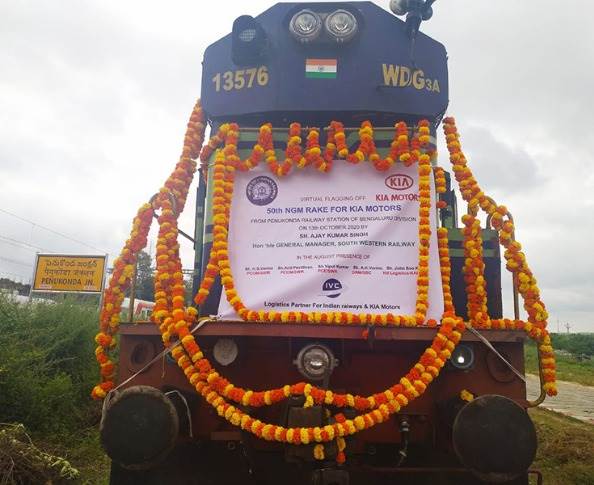
October 13 saw the flagging off of the 50th rake (train) of the Indian Railways’ new modified goods (NMG) wagons from the Penukonda junction in Andhra Pradesh, just 12 kilometres from its state-of-the-art 300,000-unit annual capacity manufacturing plant in Anantapur district.
In his tweet, Piyush Goyal, Minister of Railways and Minister of Commerce and Industry, Government of India, said, “Indian Railways is attaining new heights in the transportation of automobiles. From Penukonda, Andhra Pradesh alone, 50 rakes containing close to 5,000 cars have been despatched till now.”
The Minister also tweeted pictures of the virtual flag-off ceremony, showcasing the modified rakes as well as the Kia models being loaded into them for getting transported across India. Not surprisingly, the Sonet which has clocked over 35,000 nationwide bookings so far seems to be despatched in predominant numbers with the bigger Seltos also being a part of the total lot.
While vehicle OEMs in India have been sticking to road transportation for the logistics of their finished goods, of late, they have found benefit in using the massive rail network of the country with increasing support from the Ministry of Railways. For instance, India’s largest carmaker Maruti Suzuki has shipped over 670,000 cars using the Indian Railways Network since March 2014 and fulfilled needs of its dealers and customers in a much quicker and sustainable manner.
What is attracting Indian OEMs to use the Indian Railways’ expansive network that stretches to the farthest corners of the country is also the reliability factor and cost-competitiveness compared to traditional road transport. Along with passenger vehicles, the Indian Railways also transports commercial vehicles and tractors. With OEMs looking to rationalise costs, expect them to use the rail route much more now.
What are NMG rakes?
Freight rail is well ahead of other modes of transportation when it comes to limiting greenhouse gas emissions, increasing fuel efficiency and reducing carbon footprint. In case of Maruti Suzuki, the company claims saving close to 100 million litres of diesel and offsetting 3,000MT of CO2 by replacing heavy-duty cargo-carrying trucks with the NMG rakes.
The NMG rakes are based upon old passenger wagons which are customised to accommodate cars. The Railways removes all seats and welds the windows and side doors, thus, creating an empty capsule to load cars from the rear end. A single rake or train with up to 27 wagons is able to carry up to 125 cars of all sizes.
Benefits of rail transport over road
A single freight train can replace several trucks, freeing up space on the highways and reduce their wear and tear as well as the pressure on the government for their rebuild and maintenance. From OEMs’ perspective, some of the key benefits are:
Cost efficiency – By transporting vehicles to far-flung corners of the country using the railways, OEMs can reduce their logistics costs substantially by as much as 15-40 percent. Improved railcar design, specialised railcars, and other factors have helped increase the amount of freight railroads carry.
More fuel efficient – On an average, railroads are three-four times more fuel efficient than trucks. With as much as 125 cars, OEMs are able to despatch large volumes at one go.
High level of reliability – Fixed travel schedules, not having to share public roads and highways with other traffic means trains can travel unhindered to their destination, in all weather conditions.
With increasing focus on sustainability and the need to go green across different operations of the business, expect more carmakers to gradually start adopting railroad to make their products reach customers faster and in an eco-friendly way.
Source: AUTOCAR Professional









