
Monday, November 23, 2026
Maritime Gateway
No Result
View All Result
  • Logistics
    • Supply Chain
    • Warehousing
    • Logistics Parks
  • Transport
    • Rail
    • Trucking
    • Multimodal
    • Waterways
  • Global News
    • Americas
    • Asia
    • Europe
    • Middle East
    • Africa
  • Technology
  • More
    • Webinars
    • Reports
    • Newsletters
  • Login
Maritime Gateway
  • Logistics
    • Supply Chain
    • Warehousing
    • Logistics Parks
  • Transport
    • Rail
    • Trucking
    • Multimodal
    • Waterways
  • Global News
    • Americas
    • Asia
    • Europe
    • Middle East
    • Africa
  • Technology
  • More
    • Webinars
    • Reports
    • Newsletters
No Result
View All Result
  • Login
Maritime Gateway
No Result
View All Result

Maersk, Hapag-Lloyd Flag Landside Bottlenecks as Shipping Demand Stays Firm

byMaritime Gateway
August 17, 2026
in Economy, Forwarding, Global News, Logistics, Main Line Operators, News, Shipping, Transport, Waterways
Reading Time: 3 mins read
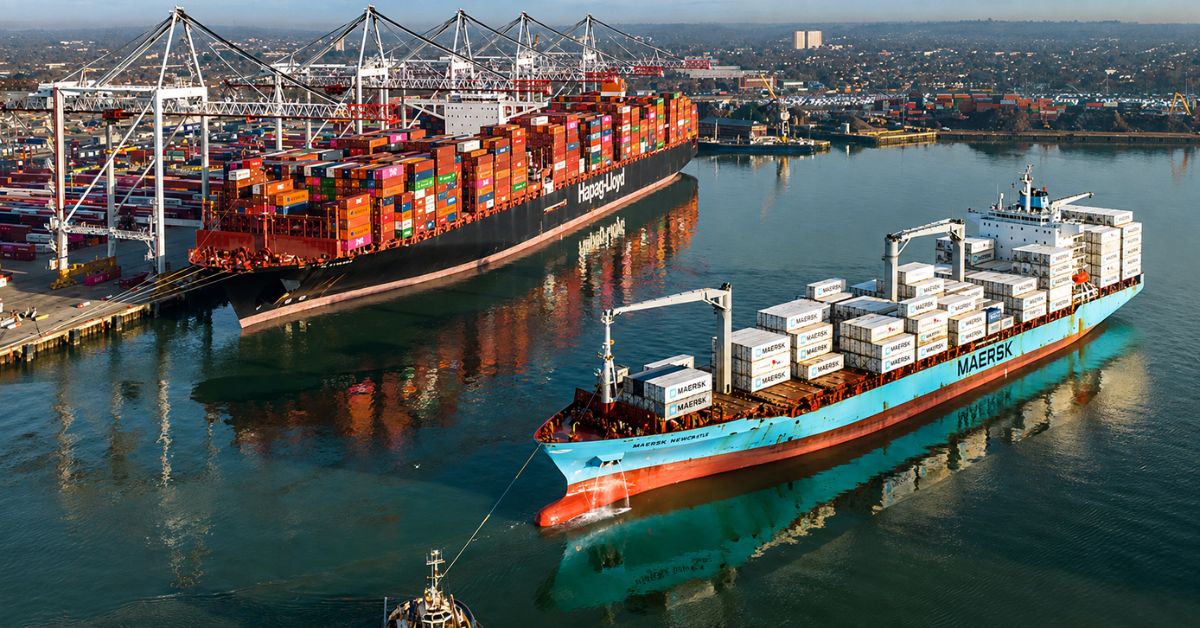
Maersk and Hapag-Lloyd second-quarter results

Maersk and Hapag-Lloyd both posted stronger-than-expected second-quarter results, but the heads of the two shipping giants warned that congestion at ports and constrained trucking, road and rail capacity are creating bottlenecks that could drive delivery delays and higher freight rates through the rest of 2026.

How resilient has shipping demand been despite geopolitical turmoil?

Maersk CEO Vincent Clerc said there has been incredible resilience of demand and of the broader economy, which has kept volumes moving virtually unabated despite the war in Iran and the impact of US tariffs. Hapag-Lloyd CEO Rolf Habben Jansen described shipping volumes as remarkably strong, noting that the balance of supply and demand has proven far more reasonable than most had anticipated.

Where are the bottlenecks emerging?

Both executives said congestion and disruption are appearing across multiple geographies, from ports to inland transportation networks. Habben Jansen pointed specifically to Asian hubs such as Shanghai, where ports are struggling to keep pace with demand and causing delays. Clerc described landside infrastructure as stretched to the maximum and underinvested, stressing that the problem extends well beyond terminals alone to trucking, rail and road capacity.

How did Maersk’s second-quarter results perform?

Maersk reported preliminary underlying EBITDA of $3 billion for the April-June quarter, comfortably ahead of the $2.04 billion analysts had expected. Revenue jumped 20 percent year-on-year to $15.8 billion, with EBIT rising to $1.6 billion from $845 million and net income reaching $1.3 billion. Freight rates were the key driver, climbing 22 percent to $2,746 per 40-foot container, powering a 23 percent jump in ocean freight revenue to $10.5 billion. Following the results, Maersk shares rose 7 percent in morning European trade after the company raised its 2026 earnings guidance for the second time this year, now expecting underlying EBITDA of $10.5 billion to $12.5 billion, up from an earlier $8 billion to $10 billion range, based on projected global container market volume growth of around 4 percent for the full year.

How did Hapag-Lloyd’s results compare?

Hapag-Lloyd’s recovery from a weaker first quarter was less dramatic but followed a similar trajectory, with revenue rising 11 percent to $5.8 billion, net income of $83 million and EBIT of $176 million. Average freight rates climbed 9 percent year-on-year. The company had already raised its 2026 earnings forecast in July, though it cautioned that the outlook remains exposed to considerable uncertainty given unpredictable freight rates and the ongoing Middle East conflict, having absorbed roughly $600 million in headwinds during the quarter linked to the disruption.

What is driving the imbalance in trade flows?

Clerc said strong, broad-based demand from the Far East since 2024 has resulted in significantly more unbalanced trade flows, with growing gaps between head-haul and back-haul volumes adding further strain to already stretched capacity. He said Maersk currently routes around a third of its normal traffic through the Suez Canal or Red Sea, covering four of its 13 services, and while conditions exist for a fuller return to Suez in 2026, the carrier is moving gradually to avoid overwhelming already-congested terminals.

What does this mean for freight rates and shippers going forward?

Clerc said the industry should expect rate events to occur much more frequently as further bottlenecks emerge across the supply chain, adding that forecasting exactly when these pressures will surface remains difficult. With both carriers pointing to a structural rather than temporary shift in market conditions, retailers and shippers face a combination of strong cargo demand, rising freight rates and logistics infrastructure increasingly struggling to keep pace through the remainder of 2026.


Tags: container freight ratescontainer shipping marketHapag-LloydMaerskPort congestion

Maritime Gateway

The Maritime Gateway Editorial Team delivers trusted news, analysis, and insights on shipping, ports, logistics, supply chains, and global trade, backed by industry expertise and editorial review.

Related Posts

India ship entry rules add salvage and pollution-response checks
Customs

India ship entry rules add salvage and pollution-response checks

October 10, 2026
NCT concession keeps ownership with Bangladesh
Asia

NCT concession keeps ownership with Bangladesh, says shipping minister

October 10, 2026
Major Ports Cargo Traffic Climbs 8% in First Half of FY27
Cargo

Major Ports Cargo Traffic Climbs 8% in First Half of FY27 as Growth Gathers Pace

October 10, 2026
Trichy Dry Port Moves Ahead
Cargo

Trichy Dry Port Moves Ahead as Tamil Nadu Shortlists Sites for Multimodal Logistics Hub

October 10, 2026

Leave a Reply Cancel reply

Your email address will not be published. Required fields are marked *

Popular News

No Content Available
[mc4wp_form]
Next Post
Allcargo Global Revenue Growth

Allcargo Global Reports 20.8% QoQ Revenue Growth in Q1 FY27

A modern news portal designed for daily coverage of breaking stories, global events, politics, business, technology, sports, and entertainment. Built to deliver fast, reliable, and engaging journalism across every major news category.
[mc4wp_form]
Browse by Category
  • 2008
  • 2009
  • 2010
  • 2012
  • 2013
  • 2014
  • 2015
  • 2016
  • 2017
  • 2018
  • 2019
  • 2020
  • 2021
  • 2022
  • 2023
  • 2024
  • 2025
  • 2026
  • Africa
  • Air Cargo
  • Americas
  • Articles
  • Asia
  • Bulk Ports
  • Bunkering
  • Business
  • Cargo
  • Container Terminals
  • Containers
  • Customs
  • Digital Dialogues
  • Dry Bulk
  • Economy
  • Entertainment
  • Equipment
  • Europe
  • EXIM
  • Featured
  • Forwarding
  • Global News
  • Government
  • Interviews
  • Lifestyle
  • Liquid Bulk
  • LNG
  • Logistics
  • Logistics Parks
  • Magazines
  • Main Line Operators
  • Middle East
  • Multimodal
  • National
  • News
  • Newsletters
  • NVOCC
  • Policy
  • Politics
  • Ports
  • Project Cargo
  • Rail
  • Recommended
  • Reports
  • Science
  • Shipping
  • Sports
  • Supply Chain
  • Tankers
  • Tech
  • Technology
  • Transport
  • Trending
  • Trucking
  • Uncategorized
  • Warehousing
  • Waterways
  • Webinars
  • World

Site Links

  • Site Admin
  • Log Out
  • Entries Feed
  • Comment Feed

Download Our App

Follow Us

© 2026 JNews – Premium WordPress news & magazine theme by Jegtheme.
  • Terms of Use
  • Privacy Policy
  • Manage Cookies
  • License

Welcome Back!

Login to your account below

Forgotten Password?

Retrieve your password

Please enter your username or email address to reset your password.

Log In
No Result
View All Result
  • Home
  • Politics
  • World
  • Business
  • Science
  • National
  • Entertainment
  • Lifestyle
  • Tech

© 2026 JNews - Premium WordPress news & magazine theme by Jegtheme.






