
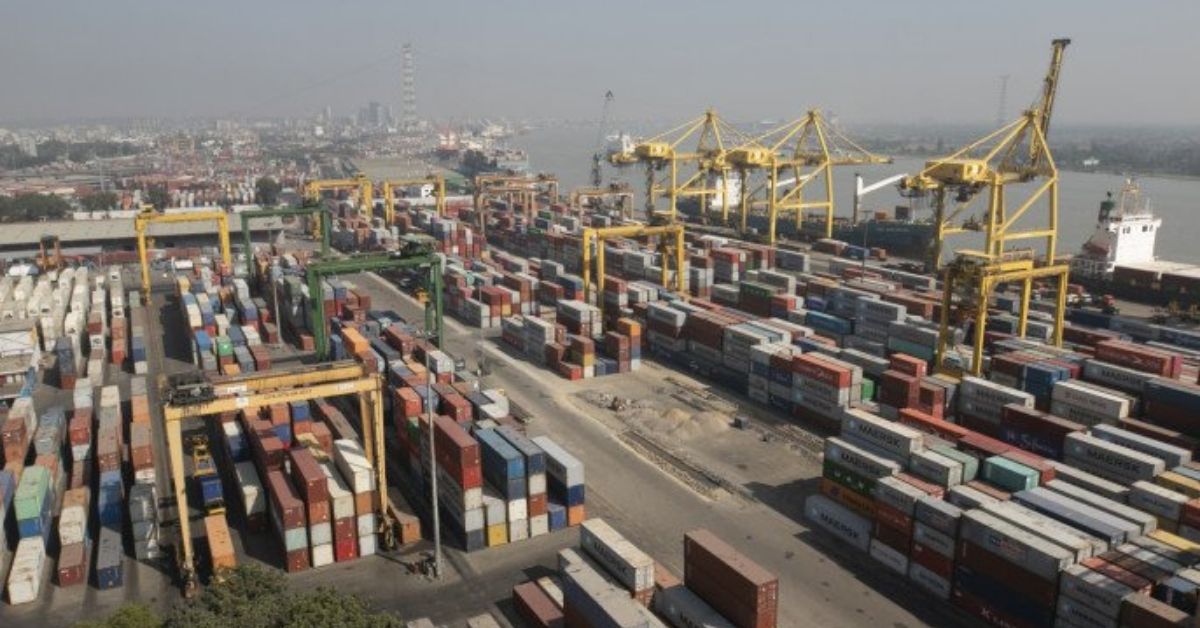
Bangladesh’s port sector is in the cusp of massive expansion that prompts stakeholders to suggest bigger private-sector involvement to ensure efficiency in operation of the seaports.
Some of the ventures involve megaprojects undertaken with foreign investment, with the aim of tapping the country’s potential to turn into a regional porting hub routed through the Bay of Bengal.
Officials say the government has recently undertaken a number of projects to modernise and expand the existing ports and to build a deep-sea port, which altogether are poised to double the container-and cargo-handling capacities of the country over next five years.
Presently, the capacity is around 4.0 million TEUs (twenty equivalent units) which is expected to rise to more than eight-million TEUs by 2026.
Commenting on the efficiencies of the expanding port sector, Centre for Policy Dialogue (CPD) Distinguished Fellow Prof Mustafizur Rahaman suggests wider and proper involvement of the private sector in port operations.
“After the engagement of the private sector, we have seen improvement in operation in Chittagong port,” Dr Mustafiz told the FE, as for example, adding that this should be continued.
“Private sector has the motivation due to incentives and competitiveness, and it resulted in improvement in port operations,” he says.
But, he suggests, the private sector should also concentrate on further improvement as there remains room for more efficient time management in operations.
Presently, Chittagong seaport alone dominates the port sector by handling 97 per cent of the country’s export-import cargos.
The port’s present capacity is around 4.0 million TEUs, and with the construction of the Bay terminal, the capacity will expand by over 2.0 million TEUs.
And the commencement of Matarbari deep-sea port will add another 2.5 million TEUs to the capacity.
Mongla seaport is also having two modernisation projects under which it is going to have another six jetties for trade handling.
Payra Port Authority has also taken up expansion project to increase its 80-metre jetty to 600-metre one. Completion of the ongoing dredging project would allow ships with 40-50 thousand DWT for berthing in the seaport.
Stakeholders like Mahbubul Alam, president of Chittagong Chamber, also pointed finger at the past predicament of the Chittagong port when cargo-and contained-handling operation was a nightmare and the port would be gripped by continuous labour unrest.
“But now the same port has advanced three steps in a year and became world’s 64th busiest port in terms of annual throughput of containers in 2021,” they said by one voice, adding that it was ranked 87th in 2014.
The 2022 edition of Lloyd’s List’s One Hundred Ports showed the Chittagong port handled a total of 3,214,548 TEUs of containers in 2021, up from 2,839,977 TEUs in the previous year, posting 13.2-percent year-on-year growth in container handling.
Cargo handling by the port posted 13-percent year-on-year growth in 2021 as the port handled a total of 116.6 million tonnes of cargos in 2021, up from 103.2 million tonnes in the previous year.
About the achievement CPA Chairman Rear Admiral M Shahjahan told the media that in the aforementioned year there was no mentionable vessel congestion and the port was in operation 24/7, which helped the trading channel handle a record number of containers in the year.
Transparency International Bangladesh (TIB) in its study report titled ‘Problems and potential of Chittagong Port: A follow-up domestic study’ presented how the involvement of the private sector changed the façade of the port.
About the pre-private period the TIB study said, “The main problems faced during loading and unloading goods into/from ships at Chittagong Port include: unjustified formation of labour gangs, excessive bribes and tips, engaging staff from stevedoring staff union, inability to control workers by the dock-workers’ management board, and frequent occurrences of worker movements.”
The study mentioned that a private-sector company named ‘Saif Power Tech’ started container handling at jetty numbers 11-13 of CCT, Chittagong Port, with the aid of four expensive and modern key gantry cranes.
According to this report, following noncooperation from port workers, the then government awarded operational responsibility to this private company from the vessel point to the cargo-delivery point for the subsequent two years under an agreement. It started its operation on 7 March 2007. This initiative was taken to reduce turn-around time and infuse dynamism in the workings of the port.
“As a result, the system of stevedoring and dock-workers is abolished. The whole work is being done by operators and labourers employed by this company,” the TIB said about virtues of privatization.
About the initial change in the efficiency the TIB report said the phenomenon of bribery which was observed up to the delivery point during the stevedoring days is apparently non-existent in the privately operated CCT.
Interestingly, this company is now handling containers in six terminals of the port and reports show that last year it handled 60 per cent of the total containers of the port.
To remain competitive, they hired experts from developed countries, officials said.
Mr Mahbubul Alam, president of Chittagong Chamber of Commerce and Industry, believes the recent achievement of the port resulted from the engagement of the private sector.
“There is no container congestion now due to the absence of labour unrest and better handling,” he says.
To increase the capacity of the Chittagong port, last month, Saudi company RGST, which operates the largest-terminal facility in Saudi Arabia at Jeddah Islamic Port, was selected by the government for construction of the Bay Terminal beside the Chittagong Port.
The new facility, being built by the Bangladeshi government, will feature a 600-metre quay and will be able to handle three vessels simultaneously, augmenting the ship-handling capacity of the prime seaport.
However, leaders of Bangladesh Garment Manufacturers and Exporters Association (BGMEA) in a recent meeting with the CPA stressed further increasing the capacity and efficiency of the Ctg port.
On the other hand, despite having far less contribution, Mongla is now set to become a key player after the opening of the Padma Bridge, which establishes direct 170km road link between the capital and the seaport.
The Chattogram Port is 260 kilometres off the capital and the Payra Port 190-km away.
Many believe the Mongla Port will be the closest and most comfortable port for businesspeople now, and completion of the rail link to the port will increase its importance manifold.
An official of the port says the port was being upgraded with a view to making it a regional trading hub for India, Nepal and Bhutan.
The port has a capacity to handle one-lakh TEUs with 50 berthing facilities, 153 cargo-handling pieces of equipment and 38 assisting vessels.
According to port officials, nine development projects are being implemented for upgrading the port that has now the capacity to handle 17.8 million tonnes of cargo a year.
With the phased implementation of the development projects, the port will be able to handle 24.9 million tonnes of goods in 2030 and 47.4 million tonnes in 2040, they said.
Under the Mongla Port master plan, it would have 11 instead of present 5.
Under public-private partnership, 50 per cent of the construction works of two jetties have already been done while two more will be built under an Indian line-of-credit loan and two others with China funding. “A new multistoried car yard, capable of accommodating 10,000 additional cars, is under construction,'” he adds.









