
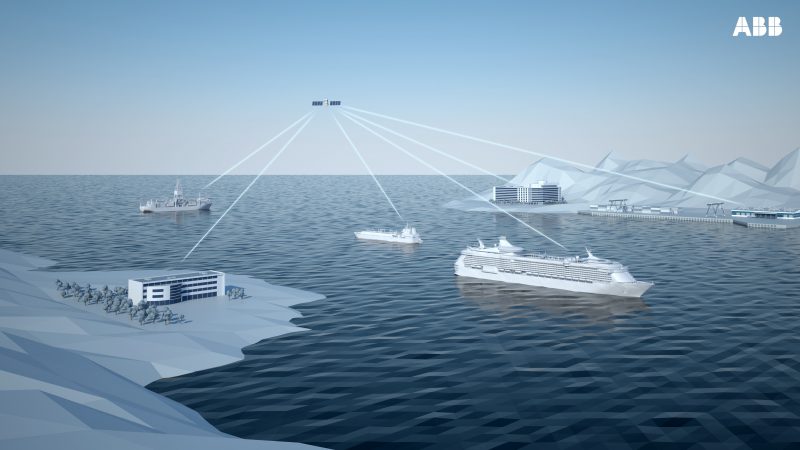
Ship autonomy tests show that a range of technologies can do the job, but clear definitions of different levels of automation, standards and regulations are urgently needed. Free from the burden of day to day commercial manoeuvring, industry alliance One Sea has the clarity of vision to guide shipping to its digital destiny
Päivi Haikkola, together with her colleague Jukka Merenluoto, head up the day-to-day operations of One Sea – an expanding ecosystem of technology heavyweights including ABB, Cargotec, Ericsson, Kongsberg and Wärtsilä. Established in 2016, One Sea now has 12 full members, having welcomed two additional new members, earlier this year. Others are waiting to sign up, Haikkola says.
Various successful pilot projects in autonomous ship operation have been completed. In fact, although digital developments continue to advance exponentially, Haikkola says we already have the technologies needed to turn pilots into working projects. She sees the main issues now as defining different levels of automation and other automation related technology, having industry-wide standards and, perhaps most importantly, the development of a regulatory framework at the IMO for global trade.
To demonstrate that shipping’s technology leaders have already developed many of the systems that will be required for autonomous operation, Haikkola lists some of the projects. The world’s first example of remote vessel operation took place in Copenhagen three years ago, she recalls.
Successful pilots
Rolls-Royce and global towage operator, Svitzer A/S, demonstrated how a ship master, located at a remote-control base in Svitzer’s city headquarters, controlled the 28m tug, Svitzer Hermod, and successfully completed a range of manoeuvres in Copenhagen harbour in 2017.
Later that year, Wärtsilä’s demonstrated how a 4,000dwt platform supply vessel (PSV), Highland Chieftain owned by Gulfmark, could be controlled remotely by a small team of tech-savvy specialists in San Diego, California, as it manoeuvred off the coast of Scotland.
This was the first time that a ship of significant size has been controlled remotely via a standard satellite link, the company claimed. Although the PSV’s master and crew were standing by throughout, their intervention was not needed as the San Diego team deployed the ship’s dynamic positioning (DP) system to complete manoeuvres in four directions. They then used DP and joystick control to carry out other tests and navigate the vessel on part of her voyage back to Aberdeen.
Then, in 2018, Wärtsilä successfully completed two separate automation tests on board the Folgefonn, a 75-vehicle, 300-passenger ferry which operates between three Norwegian ports in the south of the country. The vessel is operated by one of the country’s largest ferry groups, Norled, which has a fleet of some 80 ferries working on the Norwegian coast.
In the first test, carried out early in 2018 in the presence of the Norwegian Maritime Authority, Wärtsilä technology was tried out successfully in the autodocking of Folgefonn, while the second trial, in November of that year, involved complete autonomous operation of the ferry from dock to dock at each of the three ports on the vessel’s normal service.
There followed tests and demonstrations by both ABB and Rolls-Royce, now owned by Kongsberg, conducted separately in Finnish waters. In November 2018, ABB and Helsinki City Transport successfully remotely controlled the 2004-built ice class passenger ferry, Suomenlinna II, which has an ABB Azipod electric propulsion system and had been retrofitted with ABB Ability Marine Pilot Vision in 2017.
The test was carried out as the ferry left Helsinki’s market square, Kauppatori, and was operated remotely from a control centre in the city. Fully crewed, but with no passengers on board, the successful trial involved navigating the vessel through a pre-defined area of Helsinki harbour.
At about the same time, Rolls-Royce Marine in collaboration with state-owned Finferries, demonstrated a fully autonomous voyage completed successfully by the 54m double-ended car ferry, Falco, between Parainen and Nauvo in Finland. During the ship’s passage, guests and journalists on board were invited to see sensors and cameras enhancing the situational awareness of the crew.
Unlike some of the other pilot tests to date, the vessel used sensor fusion and artificial intelligence to avoid potential collision hazards en route and manage the automated docking of the ferry, all without human intervention. At the time, the company’s ship autonomy expert, Oskar Levander, said that new guidelines from the IMO on autonomous operation were now needed as a matter of urgency. This is a sentiment fully supported by Haikkola.
Definitions needed
“There are different levels of ship autonomy, a term that covers a range of systems which people see differently,” she says. “Unmanned, autonomous and remote control are all different concepts that need to be defined and agreed. Unless we are all talking about the same thing, our discussions with other stakeholders will be erratic. We must be clear to prevent misunderstandings.”
Autonomous and related operations, which Haikkola refers to include automated systems to support shipboard operations; autonomous ship operation supported by seagoing personnel (manned autonomous); remote control of assets from other locations; and fully autonomous operations on short defined voyages such as cargo transport between two set points, rather like a pipeline, or ferry trips across a fjord.
She also notes that early pilot tests of new systems on small vessels will continue to be carried out in designated sea areas sea such as Jaakonmeri off the coast of Finland near Turku and similar regions in Norway’s Oslo Fjord, Trondheimsfjord and Sunmøre region. However, testing has now moved to a new level, she says, involving large commercial ships.
Tests on board these vessels should be carried out during routine operation, Haikkola explains, but with close monitoring by ships’ crews. This is partly to make sure that the systems work successfully in real-life conditions and that the crew can intervene if necessary, but also to enable commercial vessels to continue to operate without delay or deviation.
Crew benefits
It is also important for ships’ crews to appreciate the benefits of autonomous operations which, she says, are not intended to replace seafarers, but to support. “The technologies under development currently are in many cases not aimed at reducing seafarer numbers. Digital tools are also intended as a support and an aid to decision-making on board ship,” she explains.
“Those who claim that the human eye is always superior are not correct. Eyes don’t work very well at night, in fog or in a major storm,” she points out. “If you can enhance situation awareness not only with radar but also with lidar, infrared and standard cameras, the seafarer is far better-placed whilst workload is eased and safety enhanced.”
In a ship-shore context, Haikkola identifies the key benefits of sensor technology, enabling shore-based specialists to track ship performance data remotely and provide virtual guidance when required. Experts can also intervene to assist in fixing problems on board if necessary.
“These technologies will benefit everyone in the shipping supply chain,” Haikkola concludes, “but we urgently need regulations.”









