
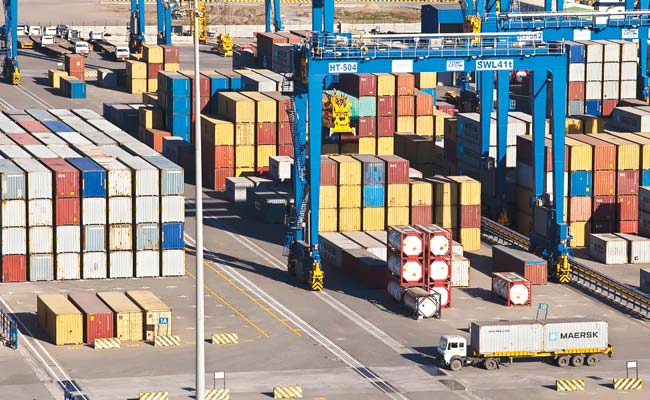
A plan to convert 11 of the 12 ports owned by the Central government and run as ‘trusts’ into ‘authorities’, will entail large-scale privatisation of cargo berths/terminals operated by the State itself.
This is because the ‘port authorities’ formed under the proposed Major Port Authorities Bill will don the role of a landlord — a model widely followed globally wherein the publicly governed port authority acts as a regulatory body and a landlord while private companies carry out port operations, mainly cargo-handling activities.
Here, the port authority maintains ownership of the port while the infrastructure is leased to private companies that provide and maintain their own superstructure and install their own equipment to handle cargo. The landlord port, in return, gets a share of the revenues from the private entity.
The 11 port trusts (Kamarajar Port is run as a company) widely follow a hybrid format of the long obsolete service port model and the preferred landlord model of port management followed globally.
Conflict of interest
This has resulted in a conflict of interest between the port trusts and the private sector, with the former acting both as port regulators and providers of commercial services in many instances.
“The involvement of the port authorities in terminal operations leads to a conflict of interest, and works against objectivity,” the National Transport Development Policy Committee, led by Rakesh Mohan, a former Deputy Governor at the Reserve Bank of India, wrote in the ‘India Transport Report: Moving India to 2032’, submitted to the previous UPA government.
Neutral authority
“The neutrality of the landlord port authority is a basic requirement for fair competition between port service providers, particularly the terminal operators. The role of the landlord port authority would be to carry out all public-sector services and operations such as the award of bids for cargo terminals and dredging.”
Privatising the cargo berths run by the State-owned ports themselves has thus become inevitable for a successful transition to the landlord model of port governance, according to a port industry consultant.
PPP potential
Of the 240 cargo berths operating at major ports (Centre-owned), 66 berths (28 per cent) are on public-private-partnership (PPP) model, while 174 are State-owned.
The PPP potential for the 174 State-owned berths can be gauged on parameters such as traffic projections/cargo growth for next 10 years (until 2025), with berths registering steady cargo growth of more than 6 per cent becoming preferred choices for privatisation, the Indian Ports Association (IPA) has suggested in a report to the ministry.
Currently, 102 of the 174 State-owned berths load multiple or general cargo.
To build financial returns, berths with dedicated cargo have greater potential for PPP.
Besides, mechanised berths, as well as berths with scope for mechanisation, have more potential for PPP since it ensures larger cargo-handling and throughput.
Berths in ports with overall strong financials — for instance, with over 20 per cent net profit — have higher potential for PPP. This will be reassuring for prospective investors interested in higher returns, the IPA stated.
PPP cargo berths/terminals at major ports have so far been awarded through the revenue-sharing mode — the bidder willing to share the most from his annual revenue wins the deal.
About 10 cargo berths have the potential to undergo PPP through the revenue-sharing model, the IPA wrote in its report.
However, some of the berths with potential for PPP may be constrained by revenue uncertainties.
New models should be explored for such berths, including viability gap funding, annuity and management contracts, it added.
If a State-owned cargo berth has no potential for PPP, it can enter into an operation and management (O&M) contract with O&M fees levied annually.
The Rakesh Mohan-led panel had favoured turning the State-run cargo terminals into public sector corporations which could potentially be disinvested, listed and possibly privatised at a later stage.









