
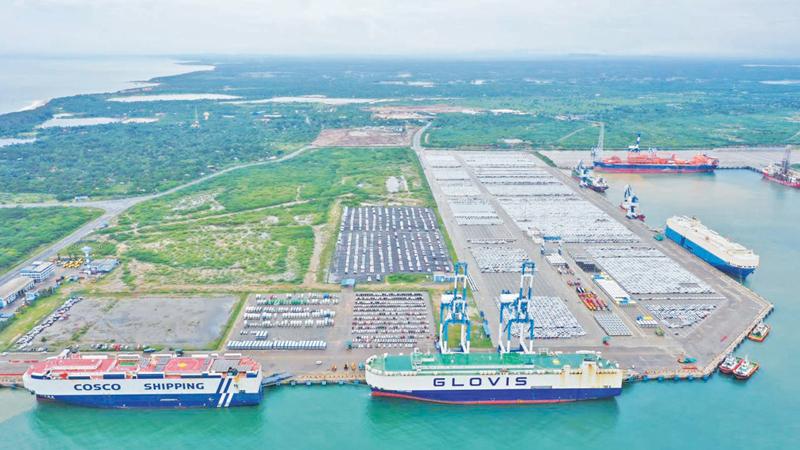
It’s just over two years since China Merchant’s Port Holding Company (CMPHC) leased Port of Hambantota for 99 years. China Merchant Port Holding owning eighty five per cent of the company whilst SLPA holding the remaining share of fifteen per cent. The Hambantota port under CMPHC has made significant strides during the past couple of years in terms of port utilisation in imports, vehicle transhipments to various other ports, ship repairs etc though local exports yet to get off the ground. It appears that CMPHC is planning different phases of port development quite rightly. With a few ships calling Hambantota now steadily, the Port intends to commence bunkering services early this year. It might be pleasing for the locals to witness Hambantota taking carefully measured steps for the business with CMPHC slowly establishing its credentials as a long-term player in the area which might see locals having their fair share of the pie in the business.
The Port of Colombo has come a long way from being a break bulk port until early 1980s, then starting its container loading and unloading of ships at QEQ (present SAGT) without any suitable equipment. It is a remarkable achievement when SLPA celebrated 7 million TEUS throughput in 2018 thanks to brave decisions taken by SLPA to develop South port. It is interesting to note that the Port of Colombo took off as a transhipment hub at a time when India was somewhat a closed economy. However much water has flowed under the bridge since then with Indian economy is entirely different, today. Colombo’s strategic location played a big part in achieving what has been achieved. Even today majority of Colombo’s transhipment business come from Indian cargo, but there is a risk looming in the horizon upon changes to ‘cabotage’ laws [which pertain to the right to operate sea, air, or other transport services within a particular territory], in India, which allows global mainliners to call Indian ports direct which were typically feeder ports from Colombo. Risk is in addition to changing shipping dynamics in the Indian Ocean in terms of emergence of regional ports other than Indian ports such as Djibouti and Gwadar. Therefore it is imperative that change its course from transhipment port to number one maritime hub in the Indian Ocean. However Colombo is restricted of further expansion beyond South port seaward or North also unavailability of suitable land closer to the port of for additional industries and services essential for a maritime hub.
Let’s see what’s might be required for Maritime hub in the Indian Ocean
- Transhipment hub for containers (Colombo might run out of capacity in the future)
- Modern Refinery, Maritime hub for oil and gas, LNG, sufficient storage capacity for different products
- LNG power generation including boil off gas as fuel gas from LNG tanks (associated with LNG imports)
- Logistic hub connecting Indian coast East and West, Bangladesh, Myanmar, Pakistan, the Maldives and other islands, East African coast, Middle East, West coast Australia and rest of the world
- Flag of opportunity for ship registration, marina and Yacht registration (Merchant shipping act needs reviewing asap)
- Closer to maritime silk route
- Bunkering including offshore bunkering (need to streamline process to simple operation, not treating bunker barges as international trading ships)
- LNG bunkering
* Offshore supplies and crew changes (need to get rid of red tapes to peace time operation)
* Dry docking and heavy lifting capacity
* Safe anchorage throughout the year for various operations (SW monsoon is not ideal for Colombo)
* Reliable, fast safe boat service day and night
* International airport within a reasonable distance
* Selection of star hotels
* Suitable training centres for service personnel
* Most importantly no red tapes, no unnecessary holding or delays and professionalism from all stakeholders and operators
Colombo, being an established transhipment port, possesses many of aforementioned attributes, but major drawbacks are a modern refinery and storage tanks for transhipping, handling and exp4orting crude oil and products, LNG bunkering facilities. There isn’t any suitable land available even for building aforesaid facilities closer to the Colombo Port. Another aspect is container handling capacity. Colombo runs the risk of capacity running out even during current slow growth time in maritime transport in the region and, therefore, it is very much likely to run out of space when maritime transport really picks up in the future in the Asian region. It may not be possible to build another port north of the South port for a container terminal similar to the South port due environmental and various other operational reasons. Unless Colombo is determined to become the maritime hub in the Indian Ocean transhipment business too might drift away to the emerging maritime hub. The SLPA has been performing very well during the past three decades mainly with the transhipment business cash flow, royalties from CICT and SAGT etc, but in case the threat looming in the horizon (changes to Cabotage laws in India and emerging ports) becomes a reality, the SLPA might be struggling, also with extremely excessive employee numbers. The SLPA surely can utilise modern technology (example – Satellite technology for automated straddles for container loading on truck loading etc to minimise manpower) and divert manpower elsewhere.
In the meantime, the Port of Hambantota is in the process of transforming the business with the CMPHC—its two companies—got plans to develop the harbour in different phases yet with a minimum number of employees. There is no doubt the Port of Hambantota will receive overflow of transhipment business from Colombo, given that the CNPHC quite rightly commenced developing the harbour, knowingly that Hambantota was not in a position to travel much distance with the current facilities. Eventually Hambantota might extend the port outward seaward similar to South port though very much in a big way, for a planned maritime hub. Hambantota is better suited for safe anchorages throughout the year as the port is somewhat sheltered from both South West and North West monsoons. Hambantota, being closer to Maritime Silk Route than Colombo, is certainly an advantage for the ships as they can save time, money and fuel. Another advantage Hambantota posses is the extent of land available for development contracted to them—some 15,000 acres. In fact, the CMPHC has the capacity to embark on building infrastructure required for a maritime hub slowly but surely. Should it be challenged in future, perhaps Colombo shouldn’t be able to hold Hambantota from developing as it might not be within rules of fair competition and equal opportunity (remains to be seen). Removing of unnecessary obstacles should help CMPHC to develop not only the port to its potential but the whole District by setting up industries, which will generate lot of job opportunities for all walks of life for the locals and others alike. The Hambantota District, upon port development, is likely have all the facilities including top national and international schools, quality hospitals and all other needs including top quality recreational facilities. The Port of Hambantota has all that is required to be the Maritime Hub of the Indian Ocean within the next couple of decades.









