
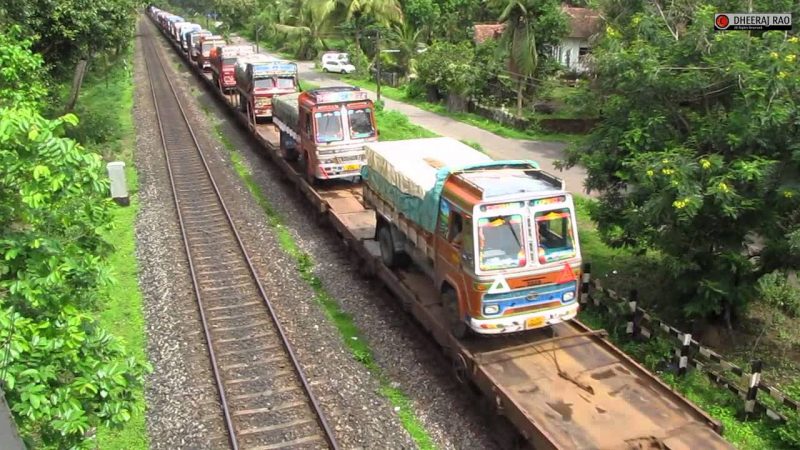
Railways has emerged as the most preferred mode of transportation for automobiles, given its low cost, faster service, reliability and safety. In 2017-18, around 29 million vehicles were manufactured in the country, registering a growth of 14.78 per cent over the same period the previous year. Given the current low car penetration, rising prosperity, and the increasing affordability of private vehicles, the automobile industry is poised to grow even faster in India. These vehicles need to be transported to the far-flung areas of the country. Railways, in recent times, has undertaken a number of initiatives to capture the automobile traffic.
Member Traffic, Mr Mohd Jamshed, said: “Year 2017-18 has witnessed a paradigm shift in the marketing efforts of Railways to attract automobile traffic and enhance our freight basket. Specially in the latter half of 2017-18, under the guidance of Minister of Railways, Mr Piyush Goyal, we decided to liberalise Automobile Freight Train Operator (AFTO) policy to encourage more private investment in special wagons, procurement of our own BCACBM (high-capacity railway wagons) and NMG wagons. In April 2018, we have taken two game-changing decisions to allow handling of automobile from all container terminals and to allow loading automobile and auto spares in privately-owned wagons in different directions for optimal utilisation of stock.”
The Railways is working closely with the automobile industry to develop policies which are mutually beneficial to the industry as well as Railways. The following noteworthy steps have been taken by the Railways in 2017-18 to attract automobile traffic:
* A meeting was held with all stakeholders in the automobile business, including Society of Indian Automobile Manufacturers (SIAM), Maruti Suzuki, Hyundai Motors, Tata Motors and automotive logistics providers, on September 28, 2017 in Rail Bhawan.
- In view of the issues raised by the stakeholders, the AFTO policy has been liberalised, viz. registration fees for the AFTO scheme has been reduced from Rs 5 crore to Rs 3 crore, and condition of minimum procurement of 3 rakes under the scheme has been relaxed to one rake. The revision was issued on October 13, 2017.
- So far, 28 routes have been notified for operation of BCACBM rakes.
- Auto hubs are now functional at Walajabad (Southern Railway) and Farukhnagar (Northern Railway). Works are underway for upgradation of facilities at these hubs. Further, the General Managers of all Zonal Railways have been asked to identify terminals to be developed as rail auto hubs.
- Conversion of 17 additional NMG rakes has been approved, of which 4 rakes have already been inducted.
- 10 BCACBM rakes have been included in Railways’ RSP for 2018-19.
- The agreement for licensing of commercial plots at Detroj in Ahmedabad division was duly agreed by Maruti Suzuki India Ltd. Loading commenced in March 2018.
The positive results of these initiatives are visible in the enhancement of automobile loading in 2017-18. During the year, automobile loading increased by 16 per cent and earning from automobile traffic went up by 18 per cent as compared to 2016-17.
In April 2018, the Railways liberalised the AFTO policy. Earlier, transportation of automobiles and auto spares by AFTOs was permitted only in one direction. With the coming up of auto hubs across the country, this restriction has now been lifted. AFTOs will be able to utilise their rakes for loading in different directions and will be able to optimise the utilisation of their rakes.
Also, automobile loading was permitted only from auto hubs, Private Freight Terminals (PFTs) and railway goods sheds with automobile handling facility. This condition had severely restricted automobile loading on account of limited availability and capacity of such terminals. It has now been decided that automobile loading/unloading shall be permitted from all Inland Container Depots (ICDs) and container terminals managed by container train operators. This will result in the availability of an additional 86 locations, other than the earlier auto hubs, PFTs and railway goods sheds with automobile handling facility.









