
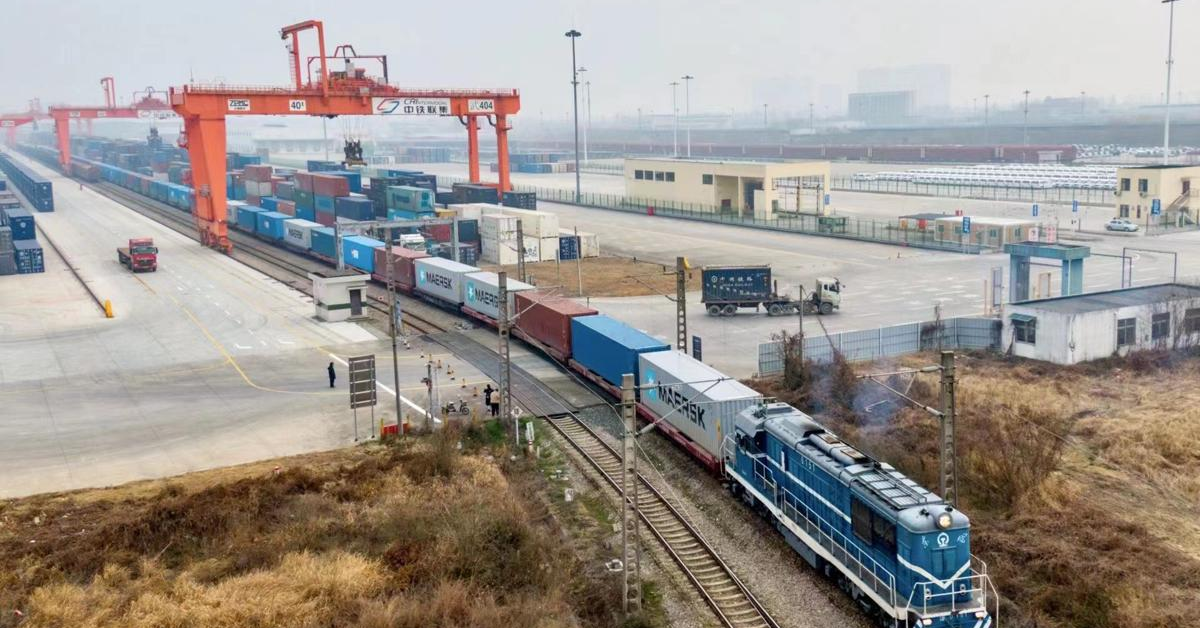
A new China-Europe freight train service connecting Wuhan and Baku via the Trans-Caspian Middle Corridor has been launched, marking the first direct rail link between the two cities and arriving at a moment when the Hormuz crisis is making shippers acutely interested in overland alternatives that bypass the disrupted Middle Eastern maritime corridors.
The inaugural train is carrying electronics, household appliances, and consumer goods for European markets along a route that passes through the Khorgos border crossing into Kazakhstan, crosses the Caspian Sea to Azerbaijan at the Port of Baku, and then continues by Azerbaijan Railways into Europe. The multimodal journey is expected to take 18 days — four days faster than traditional routing options — and strengthens Wuhan’s existing position as a key logistics hub connecting China with over 100 cities across more than 40 countries via the Belt and Road rail network.
The Middle Corridor’s Moment
The Trans-Caspian Middle Corridor — connecting China to Europe via Kazakhstan, the Caspian Sea, Azerbaijan, Georgia, and Turkey — has been gaining commercial traction for years, but has consistently struggled to compete with the Northern (Russia-transiting) Corridor on cost and the maritime routes on volume. The Hormuz crisis has created a new strategic context in which both of the Middle Corridor’s primary competitors are impaired: maritime routing through the Gulf is disrupted by the Hormuz closure, and the Northern Corridor remains under Western sanctions pressure following Russia’s war in Ukraine.
For India, the Middle Corridor has a specific strategic relevance through the International North-South Transport Corridor (INSTC) — a multimodal route connecting India to Russia and Central Asia through Iran’s Chabahar Port. While the INSTC’s Iranian section is operationally complex in the current conflict environment, the Wuhan-Baku service demonstrates that the Trans-Caspian axis is commercially viable and growing — infrastructure that could eventually form part of a resilient alternative routing architecture for India’s trade with Central Asia and Europe once the current crisis resolves.
Maersk: Rotterdam Faces Easter Congestion
At Europe’s busiest container port, Maersk has issued an advisory warning customers of potential delays at the Port of Rotterdam as Easter holiday congestion builds. The shipping giant cited a surge in cargo volumes ahead of the holiday period combined with reduced working hours and labour availability during Easter, leading to longer vessel waiting times, extended dwell periods, and slower cargo handling across key terminals. Yard congestion and limited berth availability are compounding the situation, with ripple effects expected across inland transport networks including rail and trucking. Rotterdam’s Easter congestion alert is a reminder that even without crisis-driven disruption, Europe’s port infrastructure operates near capacity during seasonal surges — and that the Cape of Good Hope rerouting that has added cargo volumes to Northern European ports is maintaining a persistent pressure on terminal utilisation that makes seasonal events like Easter more disruptive than they would normally be.
India Road Logistics: 8-10% FY27 Growth Despite Headwinds
Looking ahead, ICRA’s projection of 8-10 per cent road logistics growth in India for FY27 remains intact as the baseline forecast, supported by rising disposable incomes, income tax relief measures, and continued e-commerce expansion. The agency noted that logistics companies in its sample universe had already achieved 11.2 per cent revenue growth in the first nine months of FY26, suggesting upside potential if the Hormuz situation resolves and Gulf-bound export volumes recover in the second half of the year. The Godrej Enterprises-Tata Capital partnership to finance ₹100 crore of intralogistics equipment leasing over three years — enabling adoption of electric forklifts and material handling systems — reflects the private sector’s confidence in the sector’s structural growth trajectory even amid the current macroeconomic uncertainty.









