





Summary
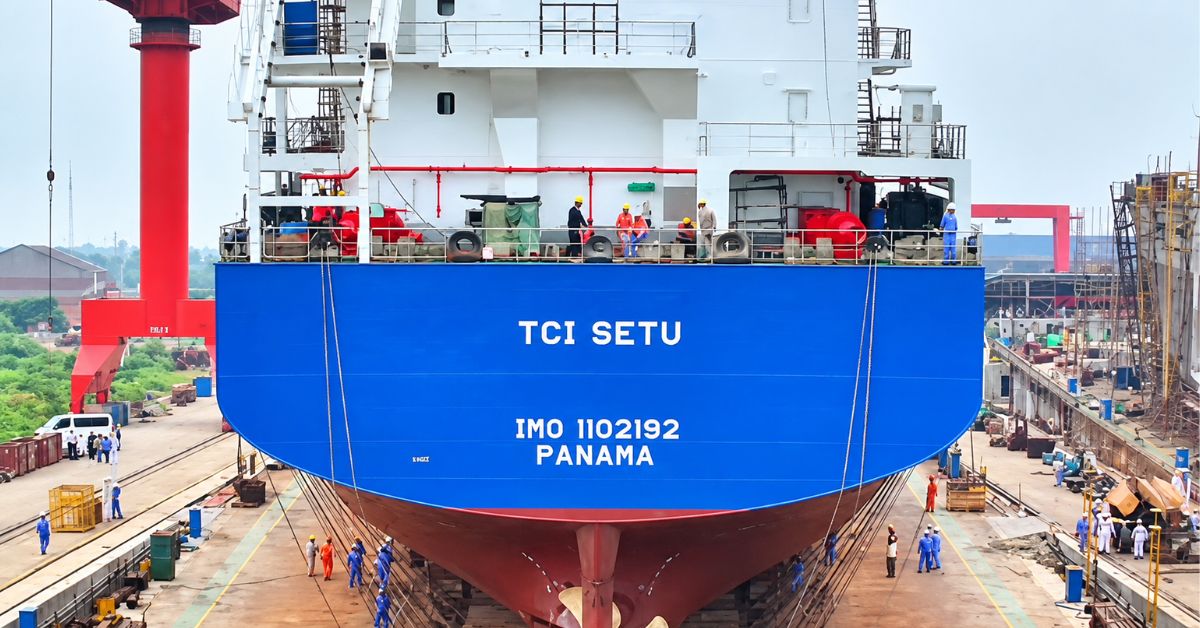
Transport Corporation of India’s Seaways division has taken delivery of TCI Setu, a 500-TEU cellular container vessel involving investment of approximately ₹178.82 crore. Funded through internal accruals, the acquisition advances a two-ship construction programme and adds capacity to the company’s maritime logistics operations.
New vessel delivered on 29 October
TCI Setu delivery was completed on 29 October 2026, adding a 500-TEU cellular container carrier to Transport Corporation of India’s shipping operations.
The company disclosed investment of ₹178.82 crore, financed through internal accruals.
The delivery follows an agreement announced in July 2024 with China’s Taizhou Sanfu Ship Engineering for two cellular container vessels, each with approximately 7,300 tonnes of deadweight capacity.
The stated purpose of the acquisition is to augment TCI Seaways’ existing shipping capacity. A specific deployment for the vessel was not identified in the delivery details.
Container capacity and cargo weight measure different things
The vessel’s 500-TEU rating describes nominal container capacity in twenty-foot equivalent units. Its deadweight specification measures the weight it can carry, including cargo and other variable loads.
These figures serve different operational purposes and cannot be compared directly.
For customers, usable cargo capacity will depend on container weights, stowage requirements and the conditions of the service on which the ship operates. A vessel’s nominal slot capacity does not mean it can carry that number of fully laden containers regardless of their individual weights.
The addition provides TCI with another maritime asset around which services can be planned. Its practical contribution will depend on deployment, sailing frequency and cargo demand.
Coastal operations connect with inland transport
TCI Seaways began as an independent sea-cargo division in February 1995 and describes its business as connecting India’s western, eastern and southern ports.
Its services include coastal shipping, container movements and first- and last-mile connectivity through road and rail. The division also provides ship management, chartering, agency, stevedoring and project-handling services.
That operating model places shipping within a wider transport chain. Containers must move between customer premises, inland facilities and ports before and after the sea leg.
For manufacturers and distributors considering coastal transport, the relevant comparison is therefore the complete origin-to-destination service, including handling and inland movement. Ocean capacity is one component of that offering.
Acquisition supports wider multimodal strategy
TCI’s FY2025–26 annual report identifies deeper integration of road, rail and sea transport among its strategic priorities.
The company also highlights asset utilisation, shipment visibility, process automation and regional trade partnerships as areas of focus.
Its logistics platform combines surface transport, warehousing, supply-chain services and coastal shipping. The report describes digital tools for tracking estimated arrival times, managing delays and handling shipment documentation.
These capabilities provide the organisational background to the vessel investment. Their commercial value lies in helping customers coordinate cargo across modes rather than treating each transport leg as an isolated transaction.
The annual report’s fleet figures describe the position before TCI Setu’s delivery and should not be treated as an updated post-acquisition inventory.
Seaways expansion accompanies stronger quarterly revenue
The delivery comes shortly after TCI announced its results for the quarter ended 30 September 2026.
Consolidated revenue from operations reached ₹1,388 crore, compared with ₹1,204.9 crore a year earlier. Consolidated net profit was ₹116.9 crore, against ₹113.5 crore.
The Seaways division’s quarterly revenue increased to approximately ₹183.6 crore from ₹142.3 crore.
Those results precede the new vessel’s delivery. TCI Setu therefore did not contribute to the reported September-quarter operating performance.
The company also appointed Bhudev Bhushan Giri as CEO-designate of TCI Seaways, effective 27 October 2026, providing a separate management development alongside the fleet investment.
Utilisation will determine commercial contribution
For TCI, taking delivery converts a shipbuilding commitment into an available operating asset. The next commercial task is to secure cargo and integrate the vessel into a dependable service pattern.
Balanced cargo flows, terminal turnaround and inland coordination will influence its productivity. Additional capacity can support growth, but the financial return will emerge through utilisation and operating performance over subsequent reporting periods.
FAQs
When was TCI Setu delivered?
On 29 October 2026.
What is its container capacity?
500 TEUs.
How much did the acquisition cost?
Approximately ₹178.82 crore.
How was it financed?
Through internal accruals.
Did it contribute to September-quarter results?
No. Delivery occurred after the quarter ended on 30 September 2026.
 Join our WhatsApp channel for more updates:
 Subscribe to our YouTube channel for more updates:




