
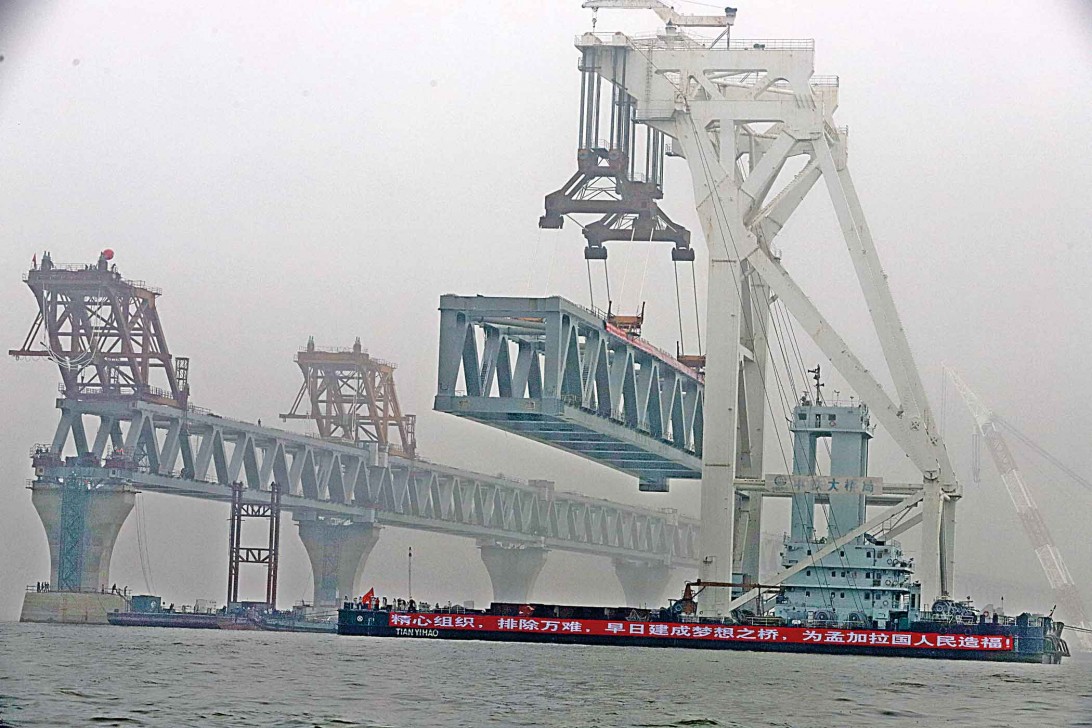
December 11, 2020: With the installation of the last span yesterday, the multipurpose Padma Bridge has connected the backward southwest region with the rest of the country and, more importantly, removed the last great geographical barrier.
The six-kilometre bridge, on the third largest river in the world in terms of mean average annual discharge, will usher in various economic opportunities once it is opened possibly sometime next year.
As the countdown began for the August occasion, economists stated that the bridge would significantly reduce travel time and distance between Dhaka and the 21 districts of the southwestern region. It will also connect the Mongla port, the second biggest seaport of the country, with the capital. The bridge can also act as a ground-breaking installation for regional connectivity and trade.
The double-decker Padma Bridge, with road and rail tracks, is expected to contribute around 1.2 percent to the annual GDP growth, reduce poverty and increase economic activities of the people of the impoverished southwest region.
“The impact of the Padma Bridge will be manifold. It will remove the last great geographical barrier that divides our country,” says Prof Mustafizur Rahman, Distinguished Fellow, Centre for Policy Dialogue (CPD).
“The country used to be divided into disjointed parts because of the two mighty rivers – Padma and Jamuna. With the construction of the Bangabandhu bridge over Jamuna, the first barrier was removed in 1998. Now, with the construction of the Padma bridge, we are close to moving towards an integrated and well-connected economy moving into the twenty-first century,” continues Prof Rahman.
Dr Zahid Hussain, former Lead Economist at the World Bank (WB), states: “The completion of the bridge is now in sight. The opening of the bridge to road and rail traffic will bring immediate benefits to the direct users. The road distance from Dhaka to nearly all major destinations in the southwest region will be reduced by 100 kilometres or more, bringing tremendous savings in the time and costs of passenger and commodity movement, vehicle operation and maintenance costs and reducing wasteful burning of fossil fuels.”
He mentions that impacts such as the increase in production and income based on the improvement of accessibility would take time and depend on other conditions in the economy. “While the Southwest Region is expected to benefit most, the reduction in the cost of internal trade will spread to economic sectors all over the country, generating additional value-added and creating new job opportunities through improved connectivity with other important cities and core facilities on the opposite sides of the Padma River,” continues Dr Hussain.
He shares that early studies have indicated that the bridge would increase the national GDP growth rate by 1.2 percent and the gross product in the southwest region by 35 percent. “It will create employment opportunities for 1.2 percent of the total labour force. Despite delays caused by funding uncertainties, implementation hiccups and cost escalation by over three times relative to the original estimate, the projected size of the excess of benefits over costs remains robust, according to most assessments,” he says. He also mentions that significant impacts are also expected on international trade between neighbouring countries such as India, Nepal, Bhutan, and Myanmar.
The economic impact in a nutshell
The southwest region covers approximately 27 percent of the country and is home to nearly a quarter of its over 160 million population. But this region has remained one of the least developed parts of Bangladesh, primarily due to lack of connectivity to the rest of the country, according to an Asian Development Bangladesh (ADB) study in 2011. “The proportion of the population below the poverty line in the southwest region remains about five percent higher than in the rest of the country,” stated the ADB report.
Taking the core districts of the southwest region, Khulna and Barisal, the difference of percentage of population under the poverty line is even more alarming—almost 10 percent higher than the national average. Besides, agricultural growth has been comparatively slow in this area due to the lack of access to markets and soil degradation due to saline intrusion and lack of fresh water in the dry seasons.
The most important bottleneck was the lack of a bridge on the Padma River, which kept the region more isolated from the eastern and north-east areas, the report observed at that time. But with Padma Bridge in sight, economic benefits from the multi-billion-dollar project are more relevant than ever before.
The Padma Bridge would save about two hours of travel time between Dhaka division and the southwest region for cars and buses and between five to ten hours for trucks, according to a World Bank study in 2011.
For instance, the travel time from Dhaka to Khulna through Paturia Ferry Ghat is around seven hours and 50 minutes
and the distance is 240 kilometres. PaturiaGhat is located 60 kilometres upstream of the Padma Bridge site at Mawa.
The Dhaka-Khulna travel time is around 12 hours and 45 minutes through Mawa Ferry Ghat, although the distance is 170 kilometres down that route due to time-consuming loading and unloading of vehicles in ferries, and also the longer distance the ferry travels compared to Paturia.
Over the Padma Bridge, the journey will take around four hours.
According to a Japan International Cooperation Agency (JICA) study, a 10 percent decrease in travel time to and from Dhaka will lead to a 5.5 percent increase in district economic output. The annual average daily traffic would be around 29,278 by 2024, as projected by ADB. The benefits of the project would be equivalent to an annual increase of at least 1.7 percent of southwest region GDP in value and of 0.56 percent of annual increase of national GDP, according to the World Bank (WB) project appraisal document in 2011.
It also said the poverty reduction rate would increase by one percent in the southwest region and by 0.8 percent at the national level.
The Padma Bridge will reduce travel time between Dhaka and Mongla port, which is shorter in distance than the Chattogram port from Dhaka – Chattogram’s 264 kilometres against Mongla’s 170 kilometres. Greater movement of freight between Dhaka-Mongla port will also reduce the congestion at the Chattogram port.
It will also provide direct links between two major seaports of the country and will be an integral part of the Asian Highway One and Trans-Asian railway network systems (Sylhet-Kanchpur-Dhaka-Mawa-Jashore-Benapole, connecting Kolkata to the eastern part of India on the eastern side of Bangladesh), said the appraisal report of WB.
The river training works of Padma Bridge will also help control river erosion, a recurrent acute problem in Bangladesh and one of the major causes of landlessness and extreme poverty. Trade and tourism could be another important source of growth. Besides internal trade, trade with India will receive a boost from lower transport time and cost.
The bridge will help maximise farm and non-farm growth possibilities, diversifying crops and agriculture in the saline environment and availing trade potential within the country due to connectivity and with India. This includes dairy and fish processing, in particular shrimp, sawmilling, jute textile and jute-bailing. With transport and energy constraints removed, the small and medium enterprises such as the garment industry, export-oriented small-scale manufacturing etc. will have strong prospects for growth, said the WB report.
The experience after the Jamuna Bridge was that labour mobility across the river went down, indicating increased economic activities within the local economy of the southwest Region.
Increased farm activities—especially the increase in vegetable production—would produce that effect. This is also expected to happen in the areas opened up by the Padma Bridge. One simulated effect of the bridge derived by use of the national SAM (Social accounting matrix) was a 10.2 percent increase in total employment over the base level. This result was consistent with what was found as a likely impact of the bridge on the gross national output.
The World Bank pulled out as lead financier of Padma Bridge with a 1.2 billion dollar pledge, on June 29, 2012, alleging “credible evidence” of a “high-level corruption conspiracy” among Bangladeshi officials to misuse money earmarked for the bridge. ADB and JICA also pulled out.
Bangladesh, however, termed the “corruption conspiracy” allegation as “baseless” and eventually decided to build the bridge from its own funds.
Source: The Daily Star









